View my previous blog here: http://bazzablog-uk.blogspot.com

I reply to all comments except spam, no matter how old!

Please ignore any email address displayed here! My email is shamp123 AT sky.com


Wednesday, 11 July 2012

Painting of the Month (31): Cindy Sherman

As I am unlikely to start a series called 'Photographer of the Month' I thought I would slip the wonderful Cindy Sherman into this series.
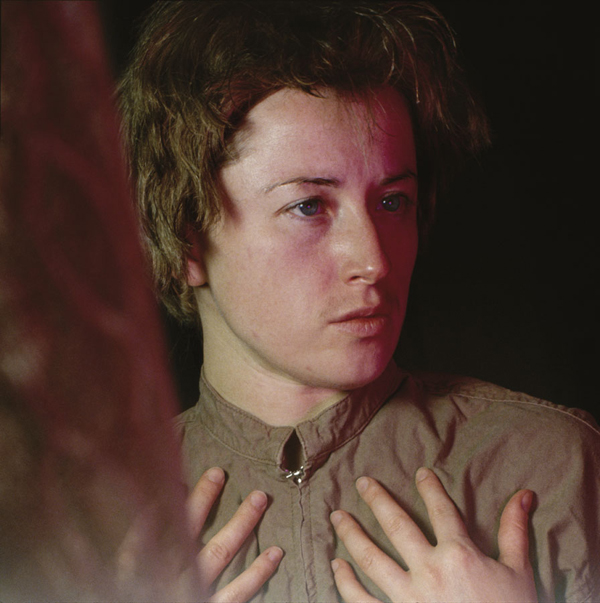
Cindy Sherman is a photographer who specialises in female portraits emulating various iconic images of women. Often they are of famous women and have the deliberate look of being movie-stills based on well-known images. The black and white picture below looks very Hitchcockian to me and the second one is like Doris Day or Debbie Reynolds. I'm not sure about the first one.


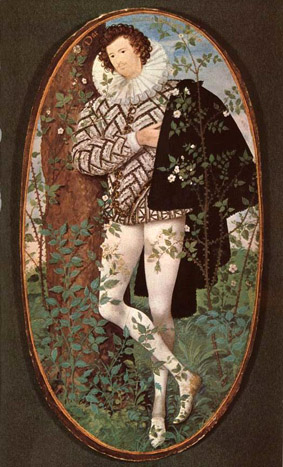
She has also produced images parodying historical portraits, centre-folds and publicity shots. They are deliberately clichéd. She is a true artist in the sense that she creates images which reflect the society we live in and holds up a mirror for us to examine our values. I don't think there is meant to be deep meaning in these photos and one should avoid 'reading-in' too much meaning in them. Just enjoy them!


In case you had not realised every one of these photos is a self-portrait of the artist!

Friday, 6 July 2012

London Monopoly (11): Bow Street

The first property in the 'Orange' set in my journey around the London Monopoly board.
The former Bow Street Magistrates Court
To most British people the name of Bow Street will be synonymous with Bow Street Magistrates Court which, from 1740 until it's closure in 2006, was the most famous magistrates court in Britain. Being located in central London it was often the first court appearance of infamous criminals and politicians (assuming there is a difference between the two!). Among the famous defendants who have appeared in the dock are Giacomo Casanova, Oscar Wilde, General Pinochet, The Kray Twins and Dr Crippen. The building was supposed to be transformed into a boutique hotel but I don't think it's happened yet. The street is also the location of the magnificent Royal Opera House. The whole area is steeped, or even drenched, in history. 
The Royal Opera House, Bow Street, Covent Garden
The Bow Street Runners, the first official 'police force' were established there in 1749 by Henry Fielding, the jurist and author of Tom Jones.
As early as 1632 the Drury Lane and Bow Street area became known as 'thieving alley' and, apparently, was increasingly  "Troblinge the adjacent areas... by lewdest Blades and female Naughty-packs" I will draw a veil of modesty over that!
The bow-shaped street was set out in 1637 with high-class housing but after the English civil war many fine houses, formerly owned by Royalists lay empty and the area deteriorated once again. After the Battle of Naseby Oliver Cromwell himself moved to live in Bow Street. After the Restoration (of the Monarchy) it became an area where the literati and low-life criminals intermingled in the newly-established coffee-houses.
Next in this series: Marlborough Street

Saturday, 30 June 2012

Why Worry?

Clink the link above for five  minutes of sublime music from true master-craftsmen. Treasure this because when they are gone something unique in the world of music will be over.
This music makes my skin tingle with pleasure and I think I've got something in my eye.
The comments on You Tube really say it all but please add your opinion here!
In the very early days!

Wednesday, 27 June 2012

My Heroes (36): Alan Turing

This week saw the 100th anniversary of Alan Turing's birth.
This is, ultimately, an extremely sad story. The name of Alan Turing should be as famous as Einstein and Newton and when he died at the age of of 41 in 1954 he should have had a state funeral. All he got was a public apology on behalf of the British government from Gordon Brown as recently as 2009. Read on to find out why.....
Alan Turing
He was an English mathematician, cryptanalyst and war-time codebreaker who had studied at Princeton in the US from 1936 to 1938. During the Second World War when Britain was standing alone against the Axis Powers and near to starvation because German U-boats were destroying Atlantic convoys bringing food to the United Kingdom. Churchill was, secretly, extremely worried. The Germans had invented the Enigma Machine which was a very advanced encoding device through which the submarines received their daily information. Realising that breaking the code was absolutely essential Turing, already known as a brilliant young mathematician, was put in charge of the top-secret 'Hut 8' at Bletchley Park in Buckinghamshire. Thanks to his brilliant efforts the secrets of Enigma were discovered with an almost instant beneficial effect on the safety of Atlantic shipping. What went on at Bletchley Park remained highly secret until long after the end of the war. In fact one of the worlds first electronic computers which used thousands of thermionic valves (tubes) was smashed to pieces after the war. The government presumably must have thought it was too dangerous to be kept going. After all, what possible use could there be for computers in peacetime?
This leads to Turing's other great claim to fame; he is generally recognised as the actual inventor of the electronic computer. Although this may be arguable, he did invent the concepts of a processor and of memory storage using binary code. He never received any public recognition of his heroic actions.
Are you wondering, dear reader, why this might be?

Alan Turing was gay at a time when homosexual practices were criminal in the UK and he had been charged with indecency two years before his death. He died of cyanide poisoning and a half eaten apple was found at his bed-side but it was never tested for poison. This has led to various conspiracy theories. His distraught mother strenuously denied that he had committed suicide and it has been postulated that the manner of his death had been a deliberately ambiguous act to spare his mother' feelings.                                                                                                                      
The late Steve Jobs denied that the half-eaten Apple trademark was a silent tribute to Turing but said "I wish to God that it had been".

It is deeply ironic that a man whose actions helped to saved thousands of lives could not save himself in the society of 1950s Britain.  It is not by chance that Google purchased his papers to donate to the London Science Museum; they know their very existence might not have happened without him.
Leonardo DiCaprio is reportedly due to star as Turing in a new film tentatively titled 'Enigma'. Good casting if he can get the stiff formal 1950's English accent right.
Bletchley Park, Buckinghamshire, England, secret headquarters of code-breakers during WW11. It is now a museum.

Wednesday, 20 June 2012

Painting of the Month (30) June 2012: Hokusai

Hokusai's 'The Great Wave off Kanagawa'
This iconic image was produced in about 1830 by the Japanese artist Katsushika Hokusai. It is a wood-block print and the first in a series depicting views of Mount Fuji. These kind of prints were usually made using cherry wood by a printer engraving from an original painting and the artist would not be involved in the process of  it's production. Many prints were made and this is an early, very high quality version.
Ying &Yang
The tension in the picture is derived from the impending crash that the huge wave is about to make. The power of the wave makes a ying-yang contrast with the space beneath it as the scared Mount Fuji sits serenely in the background. There are three fishing boats in the scene that are so cleverly interwoven that it is easy to miss them at first look. The boats would have been bringing fish from the islands around Edo (modern day Tokyo) to the mainland. It was unusual at that time to depict everyday work-related events in a painting.
I think the clean lines and pure colours make this a work of true beauty. Incidentally the artist has made good use of the, then recent, availability of a new blue pigment known as 'Berlin Blue'.

Monday, 11 June 2012

Do Not Go Gentle Into That Good Night


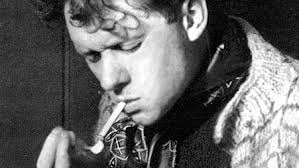
Dylan Thomas 1914 - 1953

Do Not Go Gentle Into That Good Night by Dylan Thomas
Do not go gentle into that good night,
Old age should burn and rave at close of day;
Rage, rage against the dying of the light.

Though wise men at their end know dark is right,
Because their words had forked no lightning they
Do not go gentle into that good night.

Good men, the last wave by, crying how bright
Their frail deeds might have danced in a green bay,
Rage, rage against the dying of the light.

Wild men who caught and sang the sun in flight,
And learn, too late, they grieved it on its way,
Do not go gentle into that good night.

Grave men, near death, who see with blinding sight
Blind eyes could blaze like meteors and be gay,
Rage, rage against the dying of the light.

And you, my father, there on that sad height,
Curse, bless, me now with your fierce tears, I pray.
Do not go gentle into that good night.
Rage, rage against the dying of the light.
The form of this poem is known as a vilanelle; a strict format with nineteen lines - five tercets (three lines) followed by a final quatrain of four lines. Notice that each stanza has the same ABA rhyming scheme.
The lines 'Do not go gentle into that good night' and 'Rage, rage against the dying of the light' have become iconic in their own right. The influence of this poem has become widespread since it's publication. It is an exhortation to resist the onset of death, written as his own father was dying. The poet gives the examples of how  'wise men', 'good men', 'wild men' and 'grave men' do not meekly accept the inevitable.
Television writers have borrowed deeply from the poem including Doctor Who, Northern Exposure, Mad Men and Family Guy. The poem's connotation with death and endings was used to effect in the final episodes of St. Elsewhere and Roseanne.
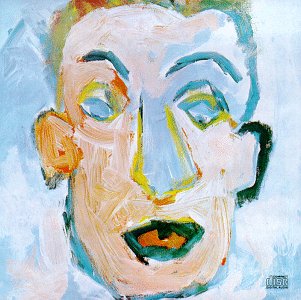
As well as taking his name from Dylan Thomas, Bob Dylan was hugely influenced by his writing style and developed Thomas's themes of conflict in his own lyric writing.

Wednesday, 6 June 2012

London Monopoly (10): Marylebone Station.

Marylebone Station facade.
First of all let's get the problematic (even for Brits!) pronunciation  of Marylebone out of the way: you say mah-l'bone (Click to listen)
Until a few years ago Marylebone was the smallest of the London termini with only four platforms but it has since been enlarged. It's certainly one of the most attractive stations and the only London terminus not to be electrified, it serves only diesel locomotives.
It is operated by Chiltern Railways and runs to Birmingham and Kidderminster and, notably, to Stratford-on-Avon - Shakespeare's birthplace. (That's nothing to do with Stratford in London where the Olympic Park is being built.)
Scenes of The Beatles first film, A Hard Day's Night were filmed there and George Harrison met his future wife, Patti Boyd, who was a schoolgirl extra in the film.
The station opened in 1899 and it's architecture, which is sypathetic to it's more urban surroundings, has made it a favourite.
www.teachingzone.org 


Monday, 28 May 2012

My Heroes (35) James Lovelock

merryenvironmentalist.files.wordpress.com
The British scientist James Lovelock is still going strong with a mind as bright as a button at the age of 92. His is a wonderful life story, of which I will relate some interesting aspects. 
He was born in Letchworth Garden City in the English county of Hertfordshire in 1919 into a working class family. His father had been illiterate until an adult and had been jailed for poaching as a young man. Realising the disadvantage he was at, he took the bold step of having elocution lessons in order to advance his career.
He has been a life-long inventor and it was while working on the freezing and thawing of cell-tissues that his distress at seeing frozen rabbits thawed by a hot spoon (which burnt their fur) that he set out to thaw them with radio waves from the inside and thus invented the microwave cooker, although he was not attempting to cook the animals!
His most famous invention is probably the electron capture detector, which measures atoms and molecules in gases. This led to the first detections of CFCs in the atmosphere.
It was the news of this invention that prompted NASA to take him to the United States in 1961 when that organisation was very young. He helped design detectors that would determine the existence or not of life on the Moon and on Mars.
However, he is best known as the proponent of the Gaia Theory which claims that the Earth is a self-regulating environment wherein all of the organic and non-organic material combine to work in harmony and sustain life on our planet. This topic, which continues to divide scientific opinion, is highly controversial and Lovelock has published many books on the subject.
I don't know if it's true or not but I would like it to be! It's rare enough to find any kind of spirituality in science.

Sunday, 20 May 2012

Quiz Questions (21): A Mixed Bag


Sir Humphry Davy
(wikimedia.org)
Q1:What did the English inventor and physician, Sir Humphry Davy, produce in 1801 about 80 years before Edison?
Q2: Which post was first held by Trygve Halvdan Lie?
Q3: Which geological feature was first described to Europeans by Father Louis Hennepin?
Q4: What, precisely, do the following books have in common?:
All My Yesterdays by Cecil Lewis
Brief Candles by Aldous Huxley
By the Pricking of My Thumbs by Agatha Christie
The Moon is Down by John Steinbeck
Something Wicked This Way Comes by Ray Bradbury
The Sound and the Fury by William Faulkner
The Way to Dusty Death by Alistair MacLean
I am off to Belgium for a few days. I will post the answers when I return at the weekend and sober up.
Have a daft guess if you don't know the answers!

Monday, 14 May 2012

London Monopoly (9): Northumberland Ave

This is the final property in the 'Pink' set on my tour of the London Monopoly board.
Northumberland Avenue runs from Trafalgar Square, down to the Thames embankment. It's a grand but fairly unremarkable street but does have some interesting history.
In 1605 Henry Howard, the 1st Earl of Northampton, cleared a site and built a huge mansion-house based on the medieval style with a great hall and separate apartments for various family members and attendants. His property had a garden that backed onto the river and adjoined Scotland Yard in the west; an unthinkably large land-holding by today's standards. The property was eventually sold to the Percy family, the Dukes of Northumberland, who owned it until it was acquired by the Metropolitan Board of Works in 1874 to make way for Northumberland Avenue to be built.
Edison House, Thomas Edison's British headquarters, were in Northumberland Avenue and historic phonograph recordings (which still exist) were made there including the voices of William Gladstone and PT Barnum. 
The Metropole Building,
geraldeve.com
One notable building is the former Metropole Hotel a grand triangular structure, built in the 1880s and often frequented by Royalty but used as government offices since 1936 .


londontown.com

Tuesday, 8 May 2012

My Heroes (34): Eric Bogle

http://www.scala.org.au
Eric Bogle is a Scottish-born Australian folk-singer and songwriter of extraordinary talents. His greatest works are the  songs about the First World war And The Band Played Waltzing Matilda and No Man's Land (also known as The Green Fields of France). He is really only known in folk-song circles which is a shame because his talents deserve much wider recognition although many fine singers have recorded his songs including Joan Baez. After more than twenty-five years I still can't hear these songs and remain dry-eyed but I am a big softie! Be warned that if you listen all the way through there will be a big emotional tug but I believe that's good for you. 
My two personal favourites of his songs are Glasgow Lullaby, a song about the sad world of the wife of "a drinkin' man" and the remarkable song Now I'm Easy about the life of an Australian farmer:
Now I'm Easy by Eric Bogle
NOTES:
Cockie: Australian small-scale family farmer
'Gin ("Jen"): an Australian aboriginal woman. (The term is nowadays considered to be derogatory)


For nearly sixty years, I've been a Cockie
Of droughts and fires and floods I've lived through plenty
This country's dust and mud have seen my tears and blood
But it's nearly over now, and now I'm easyyrics from: http://www.lyricsmode.com/lyrics/e/eric_bogle/now_im_easy.html I married a fine girl when I was twenty
But she died in giving birth when she was thirty
No flying doctor then, just a gentle old black 'gin
But it's nearly over now, and now I'm easy

She left me with two sons and a daughter
On a bone-dry farm whose soil cried out for water
So my care was rough and ready, but they grew up fine and steady
But it's nearly over now, and now I'm easy

My daughter married young, and went her own way
My sons lie buried by the Burma Railway
So on this land I've made me home, I've carried on alone
But it's nearly over now, and now I'm easy

City folks these days despise the Cockie
Say with subsidies and dole, we've had it easy
But there's no drought or starving stock on a sewered suburban block
But it's nearly over now, and now I'm easy

For nearly sixty years, I've been a Cockie
Of droughts and fires and floods, I've lived through plenty
This country's dust and mud, have seen my tears and blood
But it's nearly over now, and now I'm easy
And now I'm easy


Thursday, 3 May 2012

Painting of the Month (29) May 2012: Nicholas Hilliard

'Young Man Among Roses' painted sometime between 1585 and 1595
www.hoocher.com
Nicholas Hilliard founded the Elizabethan school of miniature portrait painting. Although, at first glance, this painting may appear unremarkable it is, in fact, extremely interesting, not least as an historical artefact. This was painted in the era of William Shakespeare's sonnet writing and the male subject is the epitome of Elizabethan romanticism; tall and handsome with dark, curly hair and an incipient moustache.
Miniature paintings were made with watercolour painted onto vellum and stretched over a piece of card about the size of a playing-card. Actually, they often were fitted onto playing-cards! The paints were often mixed in small shells and a dogs tooth fixed on the end of a small stick used to paint fine detail.
Hilliard was greatly influenced by the painting style of Hans Holbein who had died (of the plague) in 1547, and who had been court painter to Henry VIII. The style is fairly flat with strong contours and without the use of chiaroscuro, which is heavy use of light and shade. The artist reported that when he was asked to paint Elizabeth I she posed herself like this young man.
The style of the picture also tells us that the Tudor court in the 1580s was influenced by French style and was greatly francofile. 
He was originally a goldsmith like his father before him and his father sent him to Geneva as a youth to protect him from persecution as they were part of the Protestant revolution that was sweeping the country at that time. In Geneva he was exposed to the French language and culture and that influence remained with him. Despite his success he always had financial problems and he was imprisoned for debt in 1617, two years before his death.
There is an extensive collection of his work in London's fabulous Victoria & Albert museum.
Hilliard self-portrait aged about 30
www.elizabethfile.com
                                                                  

Monday, 23 April 2012

London Monopoly (8): Pall Mall

This is the eighth in my  series featuring properties on the London Monopoly board. This is the second property in the pink set.
Engraving of Pall Mall showing St. James Palace by Thomas Bowles, 1763.
UK Government Art Collection
Pall Mall is named after a  game formerly played in the area. The name derives from the Italian pallamaglio,  which literally means 'ball-mallet'. It then became Paille-Maille before it's present form. Samuel Pepys records seeing the game played by the King in nearby St. James park in the seventeenth century. 
Most of the property there is now owned by the Crown and the area is famous for the location of many long-standing gentlemen's clubs such as The Oxford & Cambridge Club, the Athenaeum and the Royal Automobile Club.
Gentleman's clubs evolved from the 17th century coffee houses as meeting places where men could find refuge from their womenfolk. However, most of the exclusive gentlemens’ clubs there today date from the 19th century.
The Royal Automobile Club, Pall Mall. (Picture: EPR Architects)


Sunday, 15 April 2012

Spotlight on a Website (6): PostSecret

www.postsecret.com
PostSecret is the world's most visited blog that carries no advertising.  I have been visiting for it for years without realising how popular it was until I saw this TED Talk. (For an introduction to TED see Spotlight on a Website 3).
The simple idea is that people email or send a postcard to Frank Warren where they anonymously reveal a personal secret and he publishes it on his website. A simple idea but a brilliant one. The results are often humorous but can be shocking, elevating, desperately sad and sometimes therapeutic.
Here are a few recent ones: 
www.postsecret.com
www.postsecret.com
www.postsecret.com
www.postsecret.com
Sometimes people send in their secrets by email.....
"I created a false Facebook page for a girl I didn't like. I made her a lesbian"

Tuesday, 10 April 2012

British v. American English (3)

I have returned to what was one of the most popular subjects when I posted previously.
www,bbc.co.uk
Some more British words and their US counterparts:
BESPOKE = CUSTOM Although we do use customised (not customized).
ANTI-CLOCKWISE = COUNTER-CLOCKWISE We don't have anything against clocks.
FRINGE = BANG A British client at a US Hairdresser might be surprised to be asked about their bangs. A bang is slang for sexual union. Oops!
BLUNT (of a knife) = DULL In the UK dull is only used to describe a personality or situation.
CODSWALLOP = BALONEY As in talking nonsense.
DO = SELL A Brit might ask, when shopping, "Do you do spare parts?"
No.(abbreviation for 'number') = #. Also HASH doesn't mean £ (that's the sign for pounds Sterling) It means MESS or SCREWED-UP.Wow, this is getting complicated (complex).
PINCH = STEAL But less serious. You might pinch a friend's newspaper but a bank-robber definitely steals.
AUBERGINE = EGGPLANT It's worth saying at this point that most US forms would be recognised (not recognized!) in the UK.
A LA MODE means 'fashionable' in the UK but means 'with ice-cream' in the US!
BISCUIT = COOKIE
SCONE (if savoury) = BISCUIT
PAVEMENT = SIDEWALK
ROAD SURFACE = PAVEMENT
CHIPS = FRENCH FRIES
CRISPS = CHIPS
Actually the grammatical differences are quite deep between the uses of the English language in the US and the UK but it's the different words that are most interesting and more fun to discuss. Any examples you know would be welcome; there are thousands!

Tuesday, 3 April 2012

Painting of the Month (28) April 2012: Hieronymus Bosch


The Garden of Earthly Delights by Hieronymus Bosch. Painted about 1490 to 1510
The Garden of Earthly Delights is a Triptych which means a three-panelled work, usually made as an altarpiece but in this case the vivid sexual nature of the painting means it probably was made for a private patron. The two outside panels fold in so it can be closed and this one has a picture of the Earth being created by God only seen when it is closed.
Triptychs are generally 'read' from left to right. The left-hand panel depicts God introducing Adam to Eve. The square central panel shows the Earthly delights being enjoyed, frequently through the medium of alarming insertions! (see Detail 1, below.) The right-hand panel is clearly meant to represent Hell. It's easy to see the message as a warning against moral sin during one's lifetime and the punishment to come for misdeeds to be meted out in the afterlife. As the majority of the population could not read, graphic illustration was often the way of telling a story as with the telling of Bible stories via the stained-glass windows of a church.
Detail 1

Detail 2
The picture above, detail 2, is from the representation of Hell. You can see that the central character seems to have an arrow sticking out of his back-side. This forms a link with the other detail; I think Mr Bosch had some kind of obsession with....well, you know what I mean. 
The picture is too large to be seen properly here but there are plenty of larger-scale images on the Internet. It's an extremely interesting picture in many ways. The historical context, the imaginative detail and, not least, the moral message are very evident.

Wednesday, 28 March 2012

London Monopoly (7): Whitehall

In my travels around the London Monopoly board I have now turned the first corner on the board and arrived at the first property in the pink set - Whitehall. Now it begins to get really interesting.
The view from Trafalgar Square down Whitehall. In the distance is the Clock Tower of the Palace of Westminster where the Houses of Parliament are. It is popularly known as Big Ben but that is actually the name of the bell itself.
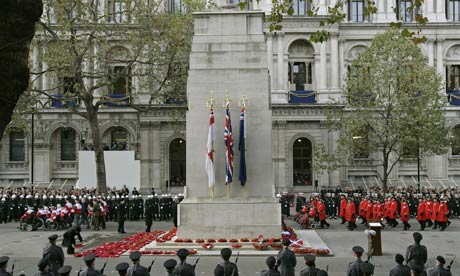
Whitehall is one of the most famous streets in the United Kingdom. Off to right at the far end is Downing Street, the official residence of the Prime Minister and the Chancellor of the Exchequer. Also, at the end of Whitehall is The Cenotaph, where the National Day of Remembrance is held for the servicemen who died in two World Wars.
The area was previously occupied by the Palace of Whitehall, destroyed by fire in 1698.
Now the whole road is lined with government Ministry buildings and the term 'Whitehall' has become a euphemism or metonym for 'Government'.
The Cenotaph, Whitehall, during a ceremony of Remembrance.

Thursday, 22 March 2012

Treasure Island

Robert Louis Stephenson's adventure, first published in 1886, is probably the finest children's book ever written. Although usually seen as 'a boy's book' it is so well written it is suitable for girls as well and adults too for that matter. The three-dimensional characters, suspenseful plot and beautifully written language which flows with rhythm and cadence make it a memorable work which, if read by a child of, say, twelve or older will stay with them for life.

Our modern-day concept of pirates is based on Long-John Silver, Blind Pew, Black Dog, Israel Hands and the other creations of Stephenson. Most pirate adventures on screen or on the page rely on the devices created by Stephenson. For example the idea of buried treasure and a secret map with 'X' marking the spot, the notion of betrayal, redemption and good versus evil are all strong elements in his writing.
Jim Hawkins, the cabin boy, who is at the heart of the story is someone that every young boy wants to emulate. The Hispaniola is possibly the most famous ship that never existed!
An interesting side-note is that Stephenson spent his honeymoon in the Napa Valley, California and used descriptions of the scenery which he wrote at the time  to describe Treasure Island. Also, after the book had been published he spent a month by the Manasquan River in Brielle, New Jersey and visited an island in the river then known as Osborn Island and now known as Nienstedt Island. He referred to it as Treasure Island and the name was popular for while.
I hope that, if you have never read this book, you are now tempted to read it. If so you are in for a treat. When I told the story to seven-year-old Sonny he wouldn't let me stop so don't deprive yourself or any children in your care! 
I won't give any more details of the plot except to say that the story opens when mysterious men come looking for a retired 'sea dog' who is living in the inn run by Jim Hawkins' parents on the south coast of England. They ransack his room looking for something but they can't find it. They leave angrily threatening to return.........

Saturday, 17 March 2012

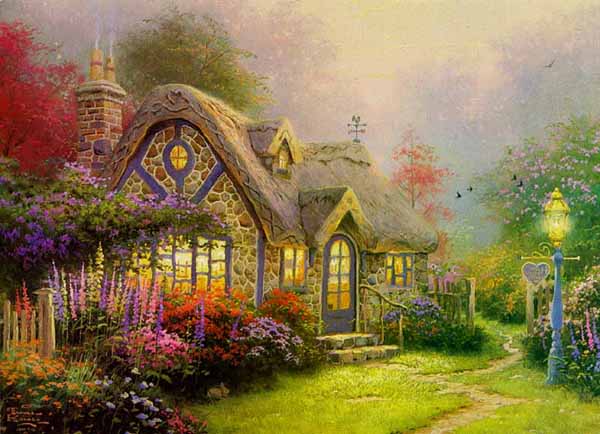
Thomas Kincade

Dear reader: You may wonder why this post is not in my Painting of the Month or My Heroes series. This article is merely my personal opinion (so he can't sue me. Anyway he should worry!). Intrigued? Read on.....
Candlelight Cottage, Thomas Kinkade
Firstly here are some definitions, from around the internet, of the word 'Kitsch', just to give you a flavour of where I am going with this:
  • Art, objects, or design considered to be in poor taste because of excessive garishness or sentimentality, but appreciated in an ironic way.
  • Kitsch is a form of art that is considered an inferior, tasteless copy of an extant style of art or a worthless imitation of art of recognized value.
  • Sentimentality or vulgar, often pretentious bad taste, especially in the arts.
  • Tawdry, vulgarized, or pretentious art, literature, etc., usually with popular or sentimental appeal
And my favourite:
  • Low art posing as high art.
If you are a collector or admirer of Thomas Kinkade you may have stopped reading by now, (about 1,000 people visit this blog every week). If you are still here, please read on.
It is not my intention to offend anyone!
I am not saying Kinkade lacks technical ability but that alone would make him suitable to be an illustrator - not an artist. Common elements of his pictures include:

  • Garish loud colours.
  • Buildings intensely lit from inside.
  • Sentimentality.
  • And never, ever, any people in his landscapes. 
His output is industrial, like that of Jeff Koons and, obviously very many people collect and admire his works.
Not me, I'm afraid.

Sunday, 11 March 2012

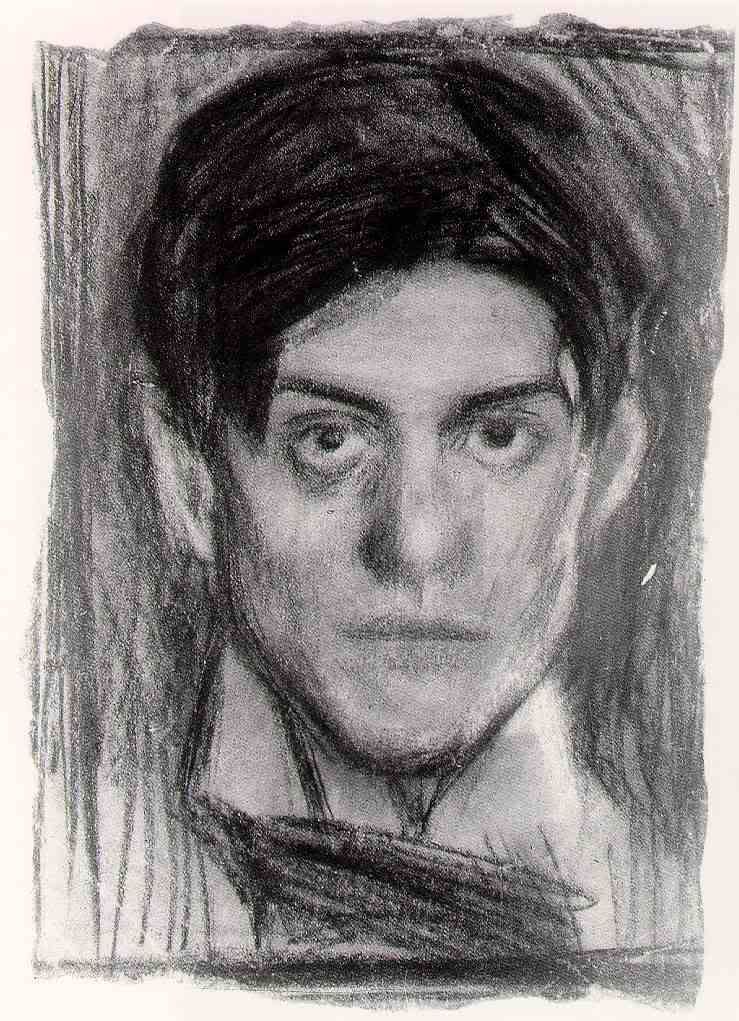
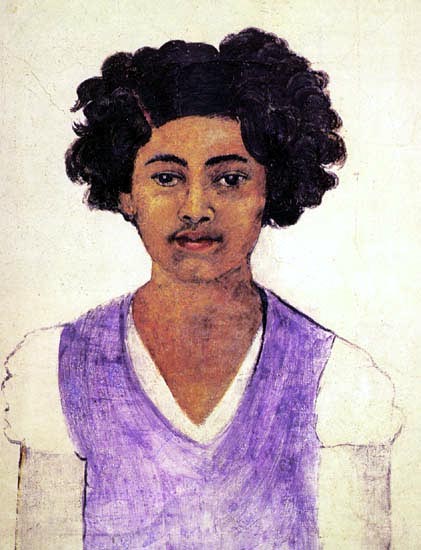
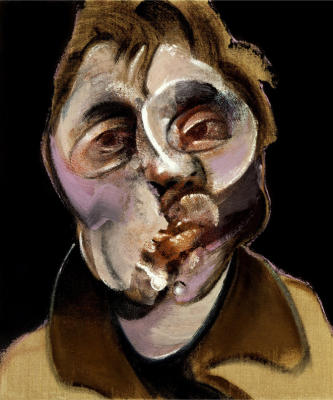
Quiz Questions (20): Self-Portraits

At last the long-promised very difficult quiz. You've been getting away with easy stuff up until now. No more Mr Nice Guy!
This tricky quiz is devious, difficult and daunting. But please have a guess at the answers; I promise not to laugh. Much.
So. Whose self-portraits are these?
(1) Whose self-portrait is this?
(2) Whose self-portrait is this?

(3) Whose self-portrait is this?


(4) Whose self-portrait is this?

(5) Whose self-portrait is this?
(6) Whose self-portrait is this?
The answers are now posted in the comments.

Tuesday, 6 March 2012

Painting of the Month (27): David Hockney

The Road Across the Wolds by David Hockney, 1997
David Hockney was born in Yorkshire, England in 1937. He lived for many years in Los Angeles but now has returned to his native country and county.
There is a major Hockney retrospective in London at the moment and now is a good time to re-evaluate his work.
Finding fame in the 1960's he did not follow the path of the then avant-garde artists such as Mark Rothko (colour-field painting) or any kind of abstract art. He has always painted what is described as 'representative' art. That means he paints a picture of something and one can tell what it is meant to be!
His most famous picture is probably 'A Bigger Splash', 1966.
His style is still recognisable today but the subject matter has changed; now he concentrates on landscapes. I like this picture because of the intensity of colour. This means it is not realistic because the light in Yorkshire is not generally like that of the south of France and lacks the intensity implied in this picture. If you find this painting a little simplistic, or even childlike, remember that Pablo Picasso once said that it took him a lifetime to learn to paint like a child!
What gives away the sophistication on show here is the clever way that the design of the picture leads the viewer's eye from the foreground though various zig-zags deep into the far distance.
I really enjoy the variety of greens on show and the way he has used green's 'complementaries' of red and orange. This has the effect of rendering the colours utilised seem even more intense.
If you like this painting you can see more of his work here.
PS: At first you only notice the large house in the foreground, but if you linger longer you will see about eight different groups of buildings!
Coming soon: a tirade against Thomas Kinkade. 
Check him out and be warned!

Wednesday, 29 February 2012

Doors & Windows (2): Kilkenny, Ireland

Photo: Patrick Comerford
This pair of beautiful Georgian doors is at 42 and 43 Parliament Street in Kilkenny, Ireland. They have individual rather than shared door casements but they do share three steps leading up to them. The Gibbsian (after James Gibbs, a Scottish architect largely responsible for the 'look' of Georgian architecture) surrounds are characteristic and the fanlights above the doors are original. However, the brightly painted doors are typical in Ireland but would be unusual in England where they are more likely to be the original black or white.
I have featured them purely for their classic splendour and I love their looks!

Thursday, 23 February 2012

London Monopoly (6): Pentonville Road


Pentonville Road is number six in my series working around the 'London' version of the monopoly board.
Top of 210 Pentonville Road
Pentonville is a small local area of north London. The name is most famous for it's prison which is actually in Caledonian Road, a little to the north in Barnsbury. Pentonville Road links Euston to The Angel at Upper Street.
It is named after Henry Penton who developed many local streets in the eighteenth century when it was largely open countryside. Since 1965 it has been part of the London Borough of Islington. 
The philosopher, John Stuart Mill was born there in 1806 and in Dickens's Oliver Twist the kindly old book-seller lived there. (But in the film Oliver they moved him to the more fashionable Bloomsbury. Pentonville Road is only in the 'Blue' set in Monopoly.) 
Apparently Lenin lived there in 1902 and that's where he first met Trotsky.
The photograph above shows 210 Pentonville Road, a new building that recycled much of the material from the former property, known as Webb House, on the site and is entirely lit by roof-mounted solar panels.
In the distance, looking towards Euston Road, you can see King's Cross Railway Station.