View my previous blog here: http://bazzablog-uk.blogspot.com

I reply to all comments except spam, no matter how old!

Please ignore any email address displayed here! My email is shamp123 AT sky.com


Friday, 7 April 2023

Artist of the Month (5): Dutch Tobacco Poster Artists

It's hard to believe but there was a time when the full implication of the health risks of smoking were not known (or were ignored).  Adverts would often portray an image of manliness & masculinity and appeal to the opposite sex. None of that changes the merits of the design and appeal of these poster ads. I love poster art and here it is in it's best manifestation.


I'm listening to Kiki Dee's beautiful song Loving and Free. You can listen to it here.

Sunday, 2 April 2023

John Donne: No Man is an Island

The phrase No man is an island is often assumed to be Shakespearean or from the Bible but it’s neither. John Donne (pronounced ‘Done’) was among the greatest of English posts and wrote some of the most beautiful love poetry of all time.     However, this isn’t originally a poem at all; it’s from a sermon given by Donne when he was the Dean of St Pauls, London.

       No Man is an Island by John Donne, written in 1623

No man is an island,

Entire of itself,

Every man is a piece of the continent,

A part of the main.

If a clod be washed away by the sea,

Europe is the less.

As well as if a promontory were.

As well as if a manor of thy friend’s

Or of thine own were:

Any man’s death diminishes me,

Because I am involved in mankind,

And therefore never send to know for whom the bell tolls;

It tolls for thee. 

It was originally published in Devotions Upon Emergent Occasions. Its subject is the interconnectedness of all mankind and, more subtly, examines the relationship between man and God and enquires what it means to be alive.   Donne is saying that people are social creatures and that no one can be truly self-sufficient; people need each other and are better together than they are apart.  He argues that “any man’s death diminishes me” and tells the reader not to ask "for whom the bell tolls." That is, they don’t need to ask who death is coming for, because it’s coming for everyone. Another implicit point here, then, is that people should cherish being alive, and, while alive, embrace being part of the wider human family.    Donne uses an extended metaphor, comparing the joining together of all people to a geographic land mass; each separate part belongs to a whole.

I'm listening to another poet; Bob Dylan's It's All Over Now Baby Blue, a song from a lifetime ago! You can listen to it here.


Thursday, 23 March 2023

Sea-Fever by John Masefield

I was once asked what, apart from my family, would I want to save if my home was burning. I realised then that my most treasured possession is a copy of Palgrave's Golden Treasury that was presented to my mother as a school prize in 1934. Palgrave's Golden Treasury of the Best Poems in the English Language is probably the most famous poetry anthology ever compiled. Originally published in 1861, it quickly established itself as the most popular selection of English poems. This edition is dated 1933 “with additional poems”. Inside, it is inscribed:

I learned a lot of poems from it and developed a life-long appreciation. Sea-Fever and Cargoes by John Masefield, who would have been Poet Laureate at the time of this edition's publication, were my two favourites.

I must go* down to the seas again, to the lonely sea and the sky, / And all I ask is a tall ship and a star to steer her by;

And the wheel’s kick and the wind’s song and the white sail’s shaking, And a grey mist on the sea’s face, and a grey dawn breaking. 

I must go down to the seas again, for the call of the running tide / Is a wild call and a clear call that may not be denied;

And all I ask is a windy day with the white clouds flying, / And the flung spray and the blown spume, and the sea-gulls crying.

I must go down to the seas again, to the vagrant gypsy life, / To the gull’s way and the whale’s way where the wind’s like a whetted knife;

And all I ask is a merry yarn from a laughing fellow-rover, And quiet sleep and a sweet dream when the long trick’s over. 

(*The word ‘go’ does not appear in Masefield’s original poem but seems to be included in every current anthology.)

This poem is very straightforward and accessible so I don't think it requires much analysis but I will say that it is a great example of alliteration & onomatopoeia

I'm listening to Bette Midler's wonderful cover of Bob Dylan's Buckets of Rain (and he is also featured on this recording!). Listen here.

Thursday, 16 March 2023

Artist of the Month (4): Ronald Searle

RONALD SEARLE (1920 – 2011,) was an English artist and satirical cartoonist, comic artist, sculptor, medal designer and illustrator. He is perhaps best remembered as the creator of St Trinian’s School inspired by his sister's school in Cambridge.  Searle was born in Cambridge and started drawing at the age of five. In 1939, realising that war was inevitable, he abandoned his art studies to enlist in the Royal Engineers. He spent much of the war in a Japanese POW camp where he witnessed awful conditions. After the war, he served as a courtroom artist at the Nuremberg trials and later the Adolf Eichmann trial in 1961.   Searle was extraordinarily prolific producing a huge volume of work, including drawings for Life, Holiday, and Punch magazines. His cartoons appeared in The New Yorker, the Sunday Express, and the News Chronicle.


I'm listening to the fabulous Joni Mitchell singing her own song 'Carey'. You can enjoy it here!


Thursday, 9 March 2023

Artist of the Month (3): Frida Kahlo Self-Portraits

FRIDA KAHLO (1907-1954), was born and raised near Mexico City and was unhappily married to the painter and muralist Diego Rivera. She had a Hungarian-Jewish father and a Spanish-Mexican mother and grew up in the midst of the Mexican Revolution, and throughout her life she would face many struggles. She contracted Polio aged six, was in a very serious bus accident at 18 and died from cancer aged 47. Although she would eventually heal from the bus accident, its memory caused her much trauma and she would often have painful relapses. She began painting in the Mexican style while confined to bed during her recovery and about a third of her 155 paintings were self-portraits. I think her work was a kind of therapy for her from her tragic life. She was popular in the 1940s but her popularity faded after her death until a revival during the 1980s feminist movement.


I'm listening to the original version of Rivers of Babylon by the Melodians. Listen here!


Thursday, 2 March 2023

London's Green Parakeets


The ring-necked green parakeet is the UK's only naturalised parrot and the most northerly breeding parrot in the world. ring-necked parakeets are originally from Africa and southern Asia and were kept as pets in the UK mainly brought in as exotic pets from Pakistan. It is estimated that there are well over 50,000 of them in London alone. They are mostly confined to the south-east of England but warmer winters will probably see them spreading further. They nest in holes in trees in gardens and parkland, and are often found in noisy, roosting flocks of hundreds of birds and they are frequent visitors to bird tables and garden feeders, particularly during the winter months. They eat nuts, seeds, berries, household scraps and fruits.  The bird has a very long, narrow tail and a bright red bill. Males have a black throat and a thin black and pink collar. Despite their tropical origin, parakeets are able to cope with the cold British winters. 

They are said to be nearing the point where they are considered a nuisance but the Royal Society for the Protection of Birds is not currently recommending a cull. However, there is now a new factor to consider. London has about 40 breeding pairs of peregrine falcons – the speediest animal on our planet. Since the first Covid Lockdown there has been a decline in the London pigeon population as tourists haven’t been there to feed them. So the falcons have turned their attention to other prey: starlings and parakeets!

I'm remembering the late Burt Bacharach by listening to one of his early songs sung by The Beatles. Listen to Baby It's You here.

Sunday, 26 February 2023

THE SECRETARY BIRD

This crazy-looking creature is a large African bird of prey. At first I didn’t believe it was real so I had to check it out. It’s real and probably the weirdest land animal of any kind.

Although a member of the order Accipitriformes, which also includes many other diurnal birds of prey such as kites, hawks, vultures, and harriers, it is placed in its own family, Sagittariidae.

The bird is instantly recognisable as a large bird with an eagle-like body on crane-like legs that give the it a height of as much as 1.3 m (4 ft 3 in). Adults have a featherless red-orange face and predominantly grey plumage, with a flattened dark crest and black flight feathers and thighs. It also has very long eyelashes which I suppose helped to give it the name!

I'm listening to the late and tragic Ronnie Lane singing You Never Can Tell on BBC's Old Grey Whistle Test in 1974. Ronnie was a founder member of The Small Faces, Faces (with Rod Stewart) and Slim Chance. He died far too young from multiple sclerosis. You can listen here. (It's best played as loud as you can stand!)


Monday, 20 February 2023

Some more funnies!

I have always enjoyed laughing in general and puns in particular. Five years ago I was invited to be an administrator on the Tim Vine Joke Appreciation Group on Facebook, which now has 277,000 members! Here are some of the things I have posted in the last few months.😊


I'm listening to Leonard Cohen's Sisters of Mercy. Does a song ever get any more beautiful than this? Listen here.

Wednesday, 8 February 2023

Artist of the Month (2): Banksy

Robin Gunningham
aka Banksy...or is he?


Banksy, commonly believed to be Robin Gunningham of Bristol, in the west of England, is the most political of artists. He started out as a graffiti artist so he wanted to keep his identity secret to avoid prosecution but he soon moved on to making clever political commentary with his paintings. They are usually painted onto the sides of buildings which has led to a debate of who actually owns them and sometimes whole walls have been sold for extremely large sums. His work is really about where it's made and what it’s saying rather than being ‘fine art’. That’s OK with me! Here are some of my favourites of his work for you to enjoy... or not!


I'm listening to Bob Dylan's "You Ain't Going Nowhere" from The Basement Tapes. Listen here!


Tuesday, 10 January 2023

University of the Third Age (U3A)

Founded in 1982, the UNIVERSITY OF THE THIRD AGE (u3a) is a UK-wide movement loosely based on the original French version. It consists of locally-run interest groups that provide a wide range of opportunities for those who are no longer in work, to come together to learn for fun (although there is no actual minimum age.) Members explore new ideas, skills and activities together. There over 1,000 branches with around 400,000 members; membership costs less than £20 on average per year.  u3a has members who draw upon their knowledge and experience to teach and learn from each other but there are no qualifications to pass – it is just for pleasure. Learning is its own reward. It is entirely voluntary and typical u3a will be home to many activity groups covering hundreds of different subjects - from art to zoology and everything in between.  

From the start, the guiding principles were to promote non-formal learning through self-help interest groups covering a wide range of topics and activities as chosen by their members. The u3a movement was to be self-funded, with members not working towards qualifications but learning purely for pleasure. There would be no distinction between the learners and the teachers – everyone could take a turn at being both if they wished. The movement grew very quickly and by the early 1990s, a u3a was opening every fortnight. 2022 saw the 40th Anniversary of the movement in the UK and they are celebrating with a year-long programme of events and celebrations. There is also a National Scheme of lectures, currently mostly on Zoom. These often feature national experts in various fields.

Personally, I run a twice-monthly Political Discussion Group and lead occasion guided, historically-based walks and occasionally I speak on various subjects, usually about art. I take part in various groups; my local Redbridge & District Group features language conversation classes, many discussion groups (general, science, art, psychology etc), pub lunches, weekend walks, knitting, gardening, cooking, play-reading, table-tennis and so on. The movement is now international in USA, Australia and elsewhere but each country has its own unique model.

UK:  https://www.u3a.org.uk/
Australia:  https://u3aaa.org/
United States: It’s covered by the Lifelong Learning Institute
I'm listening to Colin Blunstone's wonderful cover of Denny Laine's Say You Don't Mind. You can listen to it here and the original version here


Friday, 23 December 2022

Naomi Blake, Sculptor

NAOMI BLAKE, who was a sculptor, an Auschwitz survivor and a human rights campaigner died in 2020 aged 94. She had the most incredible life-story. In spite of her Holocaust experiences, Naomi believed “there is something positive in the human figure – there is a lot of good in people…with my past, if I were pessimistic, somehow, it wouldn’t have been worthwhile surviving”, thus proving her affirmation of hope and faith in humanity.

She was born as Naomi Dum in the former Czechoslovakia, the youngest of the ten children. Most of the family did not survive the war but she and her sister were put to work in a munitions factory where they learned to sabotage the bombs they were making. After their camp was liberated, they managed to escape from a death march while being fired upon by retreating German soldiers. She made her way to Palestine where she was imprisoned by the British and later helped to defend the new sate of Israel. She was wounded by shrapnel while a sub-lieutenant in the IDF. She met and married a German refugee, Asher Blake and they moved to Britain where she learned to sculpt. She is widely exhibited, with 50 of her works currently on public display all over Britain. They include Norwich, Bristol and Portsmouth Cathedrals, Great Ormond Street Hospital and Norris Lea, Kingsbury, Oxford and Leeds Synagogues. Her sculptures are also in The Hebrew and Tel Aviv Universities.
I'm listening to The Kinks singing Ray Davies's evergreen piece of social commentary, The Village Green Preservation Society. You can here it here.

Tuesday, 29 November 2022

Artist of the Month (1): Raoul Dufy

After publishing 100 Paintings of the Month, I am starting a slightly different series: Artist of the Month. 

Self-portrait 1899
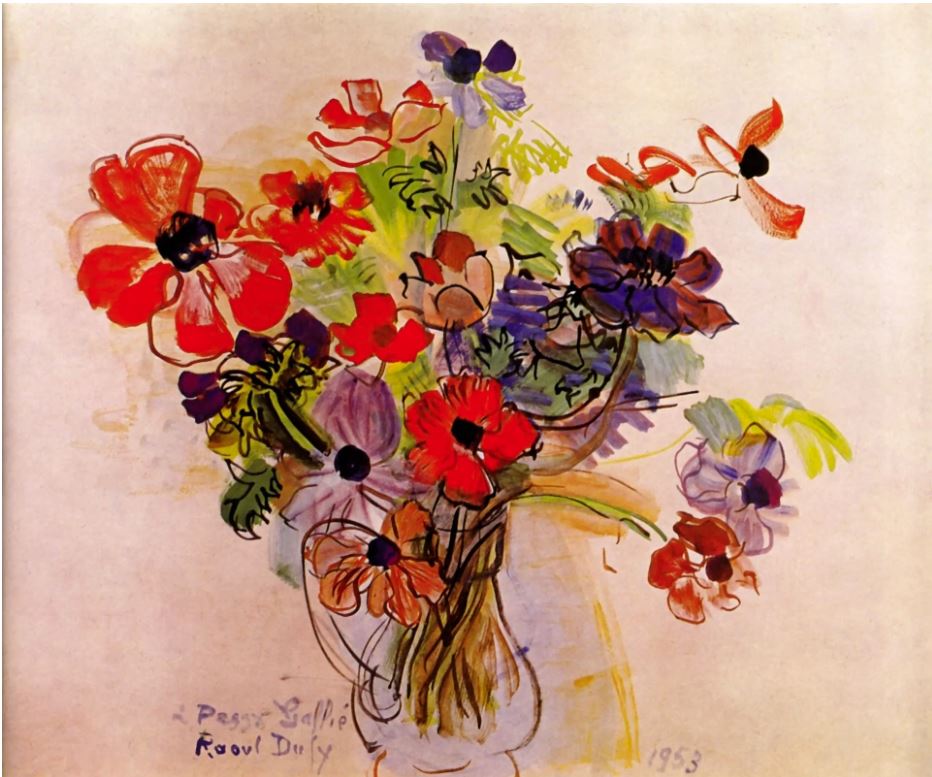
The first artist is Raoul Dufy, (1877-1953). Born at Le Havre, France, he was noted for brightly coloured and highly decorative scenes of luxury and pleasure. He went to Paris in 1900 to attend the École des Beaux-Arts. He painted in an Impressionist style in his early work, but by 1905 he had begun to employ the broad brushstrokes and bright colours typical of the Fauve artists. They favoured painterly quality and strong colour over the representational or realistic values retained by Impressionism. He started to design textiles and ceramics but in the early 1920s Dufy rededicated himself to painting and began to produce what are now his best-known works. His distinctive style is characterised by bright colours thinly spread over a white ground, with objects sketchily delineated by sensuously undulating lines. Dufy took as his subjects scenes of recreation and spectacle, including horse races, regattas, parades, and concerts.  Though very popular, his lively, carefree, elegant paintings have been criticised as occasionally bordering on the superficial. They fill me with joy!

Still Life 1928

Window Opening on Nice 1928

Anemones 1953

Venice 1937

Textile Design 1920
I'm listening to Smokey Blues Away by New Generation who later became The Sullivan Brothers. Do you recognise what piece of classical music the melody is taken from? Listen here.


Friday, 11 November 2022

The Eleanor Crosses


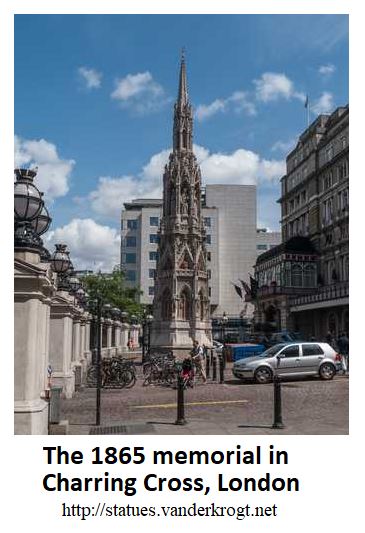
ELEANOR CROSSES were a series of twelve extravagantly decorated stone monuments topped with crosses and erected in a line down part of the east of England. They were built at the instigation of Edward I between 1291 and about 1295 in memory of his beloved late wife Eleanor of Castile. The King and Queen had been married for 36 years and she stayed by the King’s side through his many travels including on a Crusade when he was wounded at Acre. She had died in Harby, a village near Lincoln in 1290. The crosses, erected in her memory, marked the nightly resting-places along the route taken when her body was transported to Westminster Abbey in London.   The crosses stood at Lincoln, Grantham and Stamford, all in Lincolnshire; Geddington and Hardingstone in Northamptonshire; Stony Stratford in Buckinghamshire; Woburn and Dunstable in Bedfordshire; St Albans and Waltham (now known as Waltham Cross) in Hertfordshire; Cheapside in London; and Charing (now Charing Cross) in Westminster.    Three of those medieval monuments – those at Geddington, Hardingstone and Waltham Cross – survive more or less intact; but the other nine, other than a few fragments, are lost. The largest and most ornate of the twelve was the Charing Cross. Several memorials and elaborated reproductions of the crosses have been erected including, the Queen Eleanor Memorial Cross at Charing Cross Station built in 1865.

I'm listening to Nina Simone's stunning, soulful version of He Ain't Coming No More.
Listen to it HERE


Friday, 28 October 2022

Cezanne at Tate Modern

Strangely, I have not posted anything since April and now I am posting on the same topic as then - Paul Cezanne. As it was our anniversary yesterday, Leah and I spent the day in the West End of London. After a lunch by the Thames we were off to the Cezanne exhibition at Tate Modern on the South Bank. The show is exceptionally popular and one can only gain entrance by pre-booking. It was absolutely packed but the paintings were wonderful and I had seen so few of them previously. All the big subjects were there, The Bathers, The Apple & Water Jug paintings and then there’s that incredible mountain. Cezanne painted Mont Sainte Victoire in Provence over and over, from endless angles and viewpoints. It’s hidden behind trees, peeking up over rocks, spied down a valley from miles away, stared at way up close. Its stunted bulk dominates and looms, its face shimmering pink and lilac in the sun, deep blue and hushed grey in the shade. It’s a whole world effervescing, disappearing and melting. While the Impressionists painted light, Cezanne painted ideas!

These were all from photographs that Leah took at the exhibition.
I'm listening to an amazing song by Brenda Lee recorded in February 1963 when she was only 18 years old. You can listen to Losing You HERE.