,_by_Velazquez.jpg/890px-Las_Meninas_(1656),_by_Velazquez.jpg) |
| Diego Velásquez: Las Meninas, 1656, in The Prado, Madrid
This is one of the most analysed paintings of all time and is
often described as the most important work by Diego Velásquez, the leading painter of
the Spanish Golden Age. It has some incredibly unusual aspects
and things that, even today, seem to be remarkable.
The subject is the Infanta (a female daughter of
a ruling King & Queen: a princess) of Philip IV of Spain and Queen Mariana. The Infanta is surrounded
by her Maids of Honour, Las Meninas of
the title, and a dwarf, there for her entertainment. Some of the
subjects are looking out of the picture and others are interacting among themselves.
The painter himself is on the left of the picture looking at his subject – the King
and Queen who are standing where you, the viewer of the painting, are standing.
At the back of the scene their reflections can be seen in the mirror.
Also at the rear of the room a mysterious man can be observed in the doorway; it’s not
clear if he is coming or going. He helps to create depth in the scene by being
placed at the ‘vanishing point’ where the lines of perspective meet.
Notice how the light falls on the Infanta while the two maids are half-lit and form a frame around her.
Incidentally, the red cross on Velasquez's chest is the Order of Santiago, which he did not receive during his lifetime; the King had it added to the painting as a posthumous honour three years after Velasquez had died. I love the way that the long-haired young boy at the lower right is shown trying to rouse the dog from his slumber with his foot. If you click the picture to enlarge it you can see details more clearly.
Listening to Albéniz's Suite española. I seem to be having a Spanish evening!
|
Monday, 31 August 2015
Painting of the Month (56) Aug 2015: Velázquez


Tuesday, 4 August 2015
Famous Last Lines Quiz
I haven't set a quiz for a while so try this one!
Name the famous novels whose last lines are listed here.
If you don't know the answers take a crazy guess!
THE ANSWERS ARE NOW POSTED IN THE COMMENTS!

2) It's funny. Don’t ever tell anybody anything. If you do, you start missing everybody.
3) It is a far, far better thing that I do, than I have ever done; it is a far, far better rest that I go to than I have ever known."
4) I'm so glad to be at home again!
5) He was soon borne away
by the waves and lost in darkness and distance.
6) He turned away to give them time to pull themselves together; and waited, allowing his eyes to rest on the trim cruiser in the distance.
Listening to Carole King's original version of I Wasn't Born to Follow This was recorded by The Byrds and featured in Easy Rider but Carole composed it.
6) He turned away to give them time to pull themselves together; and waited, allowing his eyes to rest on the trim cruiser in the distance.
Listening to Carole King's original version of I Wasn't Born to Follow This was recorded by The Byrds and featured in Easy Rider but Carole composed it.
Friday, 17 July 2015
Painting of the Month (55) July 2015: Natalie Graham

I know very little about this low-profile artist but I like her work. More of her work can be seen here.
Listening to: ‘The Boy With The Arab Strap’ by Belle & Sebastian, an old favourite. Listen on You Tube.
Monday, 15 June 2015
Painting of the Month (54) June 2015: L S Lowry
Laurence Stephen (known as "LS") Lowry, 1887 -1976, was an English artist with one of the most recognisable styles of any painter and is often regarded as the most popular of English painters.
 |
| Industrial Landscape. L S Lowry 1887- 1976 |
Because of his distinctive style, where he painted lots of industrial landscapes often populated with large numbers of 'matchstick' people, he was often classed as a naive artist. I think being popular led to him being looked-down-upon by many art critics. I don't accept that his work is second-rate in any way; he really captured the essence of life in northern England and he conveys a real affection for his subjects making the hard grime of living in an industrialised zone appear to be not a bad thing. Here are some more of his works to give a better overview of it:


Listening to something very rare: The Everly Brothers and The Beach Boys together singing 'Don't Worry Baby'. There is a live version on You Tube but I like the studio version at this site.


 |
Friday, 17 April 2015
Painting of the Month (53): April 2015: JMW Turner
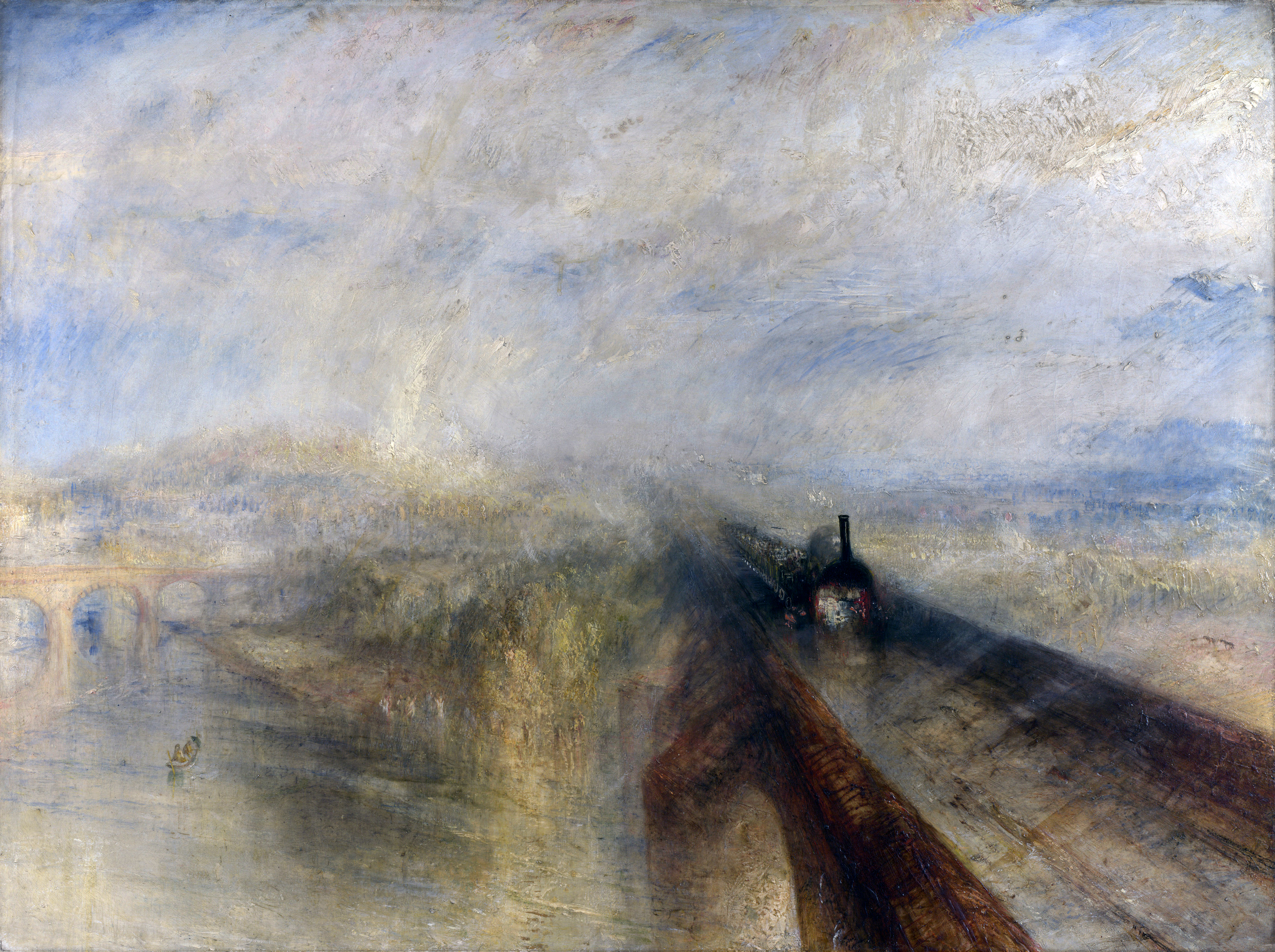
Rain, Speed and Steam: The Great Western Railway
JMW Turner, 1844, Oil on Canvas
The French
Impressionists acknowledged their debt to Turner and you can see why
in this late masterpiece. The newly-laid Great Western Railway line ran from
London to Bristol and Exeter. In this painting the train is viewed passing over
Maidenhead Viaduct across the River Thames looking back east toward London. In
his most famous painting, 'The Fighting Temeraire', Turner seemed to be
mourning the passing of the old ways as the new took over. In this one he
appears a little more sympathetic to the new technology although
I think there is some ambiguity. A tiny hare
can just about be seen in the right-hand corner of the painting
(with enlargement). This has been cited as a reference to the limits of
technology while others believe the animal is running in fear of the new
machinery and Turner meant to hint at the danger of man's new technology
destroying the inherent sublime elements of nature. A little easier to see
is the little boat on the river to the left, which may have the same purpose.
Apparently there is a ploughman in the distance, which I cannot see at all,
presumably with a similar function.
Turner has very cleverly implied the speed of
the train by the use of perspective with a central vanishing point which gives
a steep, foreshortened view, drawing the eye strongly towards the centre thus
conveying the feeling of high speed.
A further interesting point is the modern
theory to why this master inspired the Impressionists with his 'fuzzy skies':
towards the end of his life he was suffering with cataracts.
Listening to: Los Cuates De Sinaloa - 'Negro Y Azul: The Ballad of Heisenberg' from Breaking Bad. You can listen hereMonday, 6 April 2015
We Real Cool
We Real Cool is a brilliant short poem
by Gwendolyn Brooks, an African-American lady who lived in Chicago and wrote
poems about urban life there. This poem, written in 1959, is small and
exquisite like a jewel. The piece supports endless worthwhile analysis of its
meaning but beware – its simplicity is deceptive!
 |
| Gwendolyn Brooks 1917-2000 |
WE REAL COOL
The Pool
Players.
Seven at
the Golden Shovel.
We real cool. We
Left school. We
Lurk late. We
Strike Straight. We
Sing sin. We
Thin gin. We
Jazz June. We
Die soon.
The sub-title, "The Pool Players. Seven at the Golden Shovel" sets the scene just like, say, a Shakespearean stage instruction such as "Outside the Castle. Enter a Servant." It carries a lot of information for the reader and is the only really specific information in the poem. The poet has painted a picture; there are seven young guys playing pool. The number seven is often associated with gambling and the name 'The Golden Shovel' is very ironic. Pool halls are dingy, badly-lit places and 'Golden' implies sunlight, wealth and health - all absent from the scene. A shovel implies manual labour (also absent!) and hints at grave-digging which may be a signal for that punch-in-the-face moment of the last sentence.
The poem only consists of a couple of dozen words, all of a single syllable but it is laden with meaning. The poet is imagining what she thinks the young men are thinking. "We real cool. We left school." speaks volumes and we may infer that if they didn't leave or skip school they may have been saying "We are real cool. "We lurk late" hints at various possibilities of misdemeanour's. "Striking straight" implies a long time spent playing pool.
"Sing sin" hints, again at possible anti-social activities. And "We thin gin" refers to the practice among young guys in the 50s to add water to Gin, the most popular spirit at that time. In the final stanza the word Jazz is used, like the first word of the previous four lines, as an adjective. There are many differing versions of what that means, some of them unsavoury. The poetess has coyly let people make there own interpretation of it - I will do the same! So we have a bunch of school-age kids, possibly gambling, drinking and getting up to no good but we should be careful of rushing to judgement. It may all be a show of bravado.....
In the final sentence, "We die soon" Gwendolyn Brooks has probably switched to what she thinks they should be thinking or she fears may be their destiny.
The achievement of this poem is to paint a picture as powerful as a realist painting by Edward Hopper (look him up!) but with far less brush-stokes.
Listening to Clean Up Woman by Betty Wright. It has wonderful guitar and bass playing. Just try not tapping you foot to it! Listen here.
The poem only consists of a couple of dozen words, all of a single syllable but it is laden with meaning. The poet is imagining what she thinks the young men are thinking. "We real cool. We left school." speaks volumes and we may infer that if they didn't leave or skip school they may have been saying "We are real cool. "We lurk late" hints at various possibilities of misdemeanour's. "Striking straight" implies a long time spent playing pool.
"Sing sin" hints, again at possible anti-social activities. And "We thin gin" refers to the practice among young guys in the 50s to add water to Gin, the most popular spirit at that time. In the final stanza the word Jazz is used, like the first word of the previous four lines, as an adjective. There are many differing versions of what that means, some of them unsavoury. The poetess has coyly let people make there own interpretation of it - I will do the same! So we have a bunch of school-age kids, possibly gambling, drinking and getting up to no good but we should be careful of rushing to judgement. It may all be a show of bravado.....
In the final sentence, "We die soon" Gwendolyn Brooks has probably switched to what she thinks they should be thinking or she fears may be their destiny.
The achievement of this poem is to paint a picture as powerful as a realist painting by Edward Hopper (look him up!) but with far less brush-stokes.
Listening to Clean Up Woman by Betty Wright. It has wonderful guitar and bass playing. Just try not tapping you foot to it! Listen here.
Sunday, 29 March 2015
The Story of Boris
The Story of Boris
As I have been really busy with other stuff recently I am re-posting this from April 2010.
 |
| Boris, left, with his brother. |
Uncle Ben was interested in Russian literature and was reading a volume of poetry by Boris Pasternak, author of Doctor Zhivago. My grandfather came from Russia in 1906 in the wave of Jewish emigration from that place at that time and, although he spoke good enough English, he never learned to read or write it. He saw the book had a photograph of the author on the back.
"That's my cousin Boris!" he said. "No, Dad, that's Boris Pasternak" said Uncle Ben, smiling indulgently.
Granddad (known to our large family as 'Pop') insisted it was his cousin so Uncle Ben set about researching it. Pasternak's father was an artist of renown and his mother a famous concert pianist. While he was growing up Tolstoy, Scriabin, Rachmaninov and Rilke were regular visitors to the house.
His father converted to Christianity and Boris went off to University and Pop never saw him again but he was proved to be right; all of the facts he gave Uncle Ben were verified and it turns out that Bazza's grandfather was Boris Pasternak's first cousin.
I think it means that I share about 1.5% of my genes with a Nobel Prize winner. Explains a lot don't you think?
I'm listening to the Dixie Chick's 'Landslide'. I actually prefer it to Fleetwood Mac's original. You can listen here.
Friday, 20 February 2015
My Last Duchess
Because I love this poem so much I have rehashed a post from five years ago. Even if poetry is not your 'thing' please take a few minutes to read this poem and then read my shocking revelation at the end. You will probably re-read the poem and you might, like I did, when first introduced to Robert Browning's poem thirty years ago find your jaw is on your chest with open-mouthed amazement! Sometimes in art and literature the best rewards come when one has to work at bit at understanding what is being presented.....
The single word Ferrara at the beginning would have set the scene for 19th century readers of this poem. It is set in the sixteenth century Italian city-state of Ferrara. The speaker is probably Alfonso, Duke of Ferrara who is showing a courtier around his privately commissioned works of art. A painting of His last Duchess is hidden behind a curtain ("...none puts by the curtain I have drawn for you but I...")
He describes her as if one of his many possessions and tells how she rated the friendship and attention of others above the gift of his "nine hundred years old name".
When I first read this poem my blood ran cold and I was genuinely shocked when I realised what the Duke was implying:
"......I gave commands;
Then all smiles stopped together.
There she stands as if alive".
He's had her killed! Oh my God! He talks about her as if she were faulty goods that he had to be rid of. Please read the poem again with this knowledge and notice how cleverly Browning has shown the casual nonchalance of the Duke.
At the end he is preparing to go downstairs to size up his next potential wife while talking about some of his other possessions. The Duchess was 17 years old when she died.
Chilling; the work of a master poet.
 |
| Lucrezia de Medici by Bronzino c.1560 Generally considered to be My Last Duchess
My Last Duchess
by Robert Browning (1812-1889)
Ferrara
That's my last duchess painted on the wall,Looking as if she were alive. I callThat piece a wonder, now: Frà Pandolf's handsWorked busily a day, and there she stands.Will't please you sit and look at her? I said"Frà Pandolf" by design, for never readStrangers like you that pictured countenance,The depth and passion of its earnest glance,But to myself they turned (since none puts byThe curtain I have drawn for you, but I)And seemed as they would ask me, if they durst,How such a glance came there; so, not the firstAre you to turn and ask thus. Sir, 'twas notHer husband's presence only, called that spotOf joy into the Duchess' cheek: perhapsFrà Pandolf chanced to say "Her mantle laps"Over my lady's wrist too much," or "Paint"Must never hope to reproduce the faint"Half-flush that dies along her throat": such stuffWas courtesy, she thought, and cause enoughFor calling up that spot of joy. She hadA heart how shall I say? too soon made glad,Too easily impressed; she liked whate'erShe looked on, and her looks went everywhere.Sir, 'twas all one! My favor at her breast,The dropping of the daylight in the West,The bough of cherries some officious foolBroke in the orchard for her, the white muleShe rode with round the terrace all and eachWould draw from her alike the approving speech,Or blush, at least. She thanked men good! but thankedSomehow I know not how as if she rankedMy gift of a nine-hundred-years-old nameWith anybody's gift. Who'd stoop to blameThis sort of trifling? Even had you skillIn speech which I have not to make your willQuite clear to such an one, and say, "Just this"Or that in you disgusts me; here you miss,"Or there exceed the mark" and if she letHerself be lessoned so, nor plainly setHer wits to yours, forsooth, and make excuse,E'en then would be some stooping; and I chooseNever to stoop. Oh sir, she smiled, no doubt,Whene'er I passed her; but who passed withoutMuch the same smile? This grew; I gave commands;Then all smiles stopped together. There she standsAs if alive. Will't please you rise? We'll meetThe company below, then. I repeat,The Count your master's known munificenceIs ample warrant that no just pretenseOf mine for dowry will be disallowed;Though his fair daughter's self, as I avowedAt starting, is my object. Nay we'll goTogether down, sir. Notice Neptune, though,Taming a sea-horse, thought a rarity,Which Claus of Innsbruck cast in bronze for me!
|
He describes her as if one of his many possessions and tells how she rated the friendship and attention of others above the gift of his "nine hundred years old name".
When I first read this poem my blood ran cold and I was genuinely shocked when I realised what the Duke was implying:
"......I gave commands;
Then all smiles stopped together.
There she stands as if alive".
He's had her killed! Oh my God! He talks about her as if she were faulty goods that he had to be rid of. Please read the poem again with this knowledge and notice how cleverly Browning has shown the casual nonchalance of the Duke.
At the end he is preparing to go downstairs to size up his next potential wife while talking about some of his other possessions. The Duchess was 17 years old when she died.
Chilling; the work of a master poet.
Friday, 13 February 2015
Painting of the Month (52) February 2015:Millais
 |
| Ophelia. Sir John Everett Millais, 1852
Four years before this painting was made the Pre-Raphaelite Brotherhood was formed in London in 1848. Millais was one of the three founder-members whose main idea was to return to the style of art that they thought should dominate. They objected to the classical style that Raphael and others has promoted, favouring instead great attention to detail, nature and bright colours. In particular they objected to the founder of the English Royal Academy, Sir Joshua Reynolds; apparently they referred to him as "Sir Sloshua". On the whole I don't go too much on their work but I think this particular painting is a bit special.
Ophelia was the character in Shakespeare's Hamlet who is depicted drowning in a Danish river. Her death does not occur on stage but is eloquently described by Queen Gertrude, Hamlets's mother. She fell from a branch into the water and floated without trying to rescue herself because her voluminous dress filled with air and kept her buoyant. However, the dress eventually became saturated and she drowned. Another character suggests it was suicide. (Prince Hamlet had rejected her because he was pre-occupied with his 'To be or not to be' soliloquy in which he contemplates the attractions of suicide - it's a laugh a minute is Hamlet.)

There is a very interesting story about Elizabeth Siddal, left, who was a favourite model for many of the Pre-Raphaelite painters and poets. Millais had her posed in a bath of cold water for many hours during the winter while he meticulously painted. (He had previously spent months outdoors painting the scenery ). Small lamps were lit under the bath-tub but they were inadequate to keep the water warm. 'Lizzie' became ill, possibly with pneumonia so her father threatened legal action action against Millais, who ended-up paying all of her hospital bills. Others have speculated that it was her addiction to laudanum that had made her ill. Life imitating art?
Sir John Everett Millais was born in Southampton, England in 1829 and died in Kensington , London in 1896.
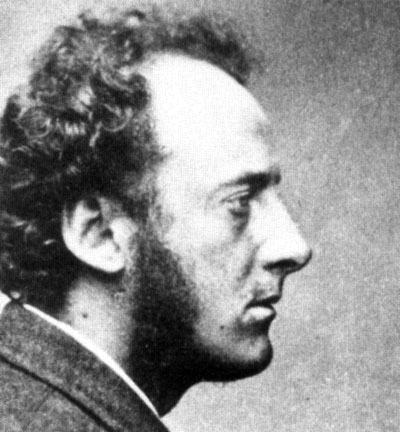
Sir John Everett Millais
|
Saturday, 3 January 2015
Letchworth Garden City
About 40 miles from the centre of London, in the County of Hertfordshire, south-east England, lies Letchworth, the world's first garden city.
 |
| Letchworth from the air (www.letchworth.com) |
Letchworth, Willian and Norton were three villages all mentioned in the Domesday Book of 1068 and the area that they covered was to form the basis of the Garden City in 1903. The 'green belt' movement also began there; this was a way of controlling building to stop the expansion of towns and cities. There is a huge one around London and it is almost impossible to get permission to build on 'greenfield' sites. This has the effect of limiting urban growth (and inflating property prices). The population of Letchworth is around 34,000 and remains steady. It is an early example of modern town planning and a deliberate mix of urban and rural elements. It remains a very attractive and desirable place to live.
 |
The Mercure Letchworth Hall Hotel where we stayed last weekend.  Letchworth is also the location of the UK's first roundabout (traffic circle)  The town is also the home of this noted Art Deco cinema of 1936  ......and of this charming old railway station (1903) ......and of this charming old railway station (1903) |
One other unusual thing about Letchworth is it's legal format. It is believed to be the only community where a charitable trust, rather than elected representatives actually controls ownership of land and property. In effect all of the shops and commercial properties pay 'rates' and any surplus money is fed back into the local economy..
Listening to: On The Rocks, the University of Oregon's acapella singing group performing an open-air version of Lady Gaga's 'Bad Romance'. It's poor quality vision and sound, probably shot on someone's phone, but hilarious to watch and wonderful to listen to: https://www.youtube.com/watch?v=x6IEV2dJbSE
Listening to: On The Rocks, the University of Oregon's acapella singing group performing an open-air version of Lady Gaga's 'Bad Romance'. It's poor quality vision and sound, probably shot on someone's phone, but hilarious to watch and wonderful to listen to: https://www.youtube.com/watch?v=x6IEV2dJbSE
Friday, 26 December 2014
Answers to the Christmas Quiz and a new question.::
Here are the answers to the Christmas Quiz which was obviously not hard enough! Next time it will be extra difficult! Also, at the end, there is a bonus Christmas question that will really make you think. Probably.


1) The Latin word meaning
'coming' gave us what term which still refers to the coming Christmas period?
ADVENT means coming or arrival
2) In which European
language does 'Nadolig Llawen' mean Merry Christmas? WELSH
3) Who composed the
Lieutenant Kijé orchestral suite, part of which is a familiar piece of Christmas
music? PROKOFIEV
You can here it here
4) In which fictional place
was it always winter but never Christmas? NARNIA from C S Lewis's The Lion, The Witch and The Wardrobe
5) In which continent did turkeys originate.....? (In the UK we don't
celebrate Thanksgiving but, traditionally, eat turkey at Christmas.) NORTH
AMERICA, the US and Mexico.
6).....and why are turkeys so-called? Because they were first
brought to Europe by Turkish merchant ships (and were thought to have come from
India).
Well done to those who got them (even by 'research'!)
And here as promised is the new question:
In the lyrics of Elvis Presley's song Blue Christmas there are three other colours mentioned. What are they? If it's too much for your brain listen here
Sunday, 21 December 2014
Quiz Questions (22): Christmas Quiz
It's a while since I posted a quiz so here is a new selection of harder Christmas questions. Cheating is definitely allowed! I wish all readers of this Blog a peaceful holiday season and prosperous new year!
 |
| Over 1,000 Santas took part in a Charity Run in Bristol, England last weekend. Your correspondent was there! |
1) The Latin word meaning 'coming' (oh, behave!) gave us what term which still refers to the coming Christmas period?
2) In which European language does 'Nadolig
Llawen' mean Merry Christmas?
3) Who composed the Lieutenant Kijé orchestral
suite, part of which is a familiar piece of Christmas music?
4) In which fictional place was it "always winter
but never Christmas"?
5) In which continent did turkeys originate.....? (In the UK we don't celebrate Thanksgiving but, traditionally, eat turkey at Christmas.)
6).....and why are they so-called?
https://www.youtube.com/watch?v=4wr4jIWl6545) In which continent did turkeys originate.....? (In the UK we don't celebrate Thanksgiving but, traditionally, eat turkey at Christmas.)
6).....and why are they so-called?
Listening to 'Linda Paloma' by Jackson Browne:
and there is a good a live version:
https://www.youtube.com/watch?v=KLd76ZXGDO4
Thursday, 4 December 2014
Painting of the Month (51) December 2014: Manet
In 2005 a BBC Radio station ran a competition where listeners voted for their favourite painting in the UK. For the next few items in this series I will be featuring a random selection of those pictures. By 'random' I mean paintings that I personally like!
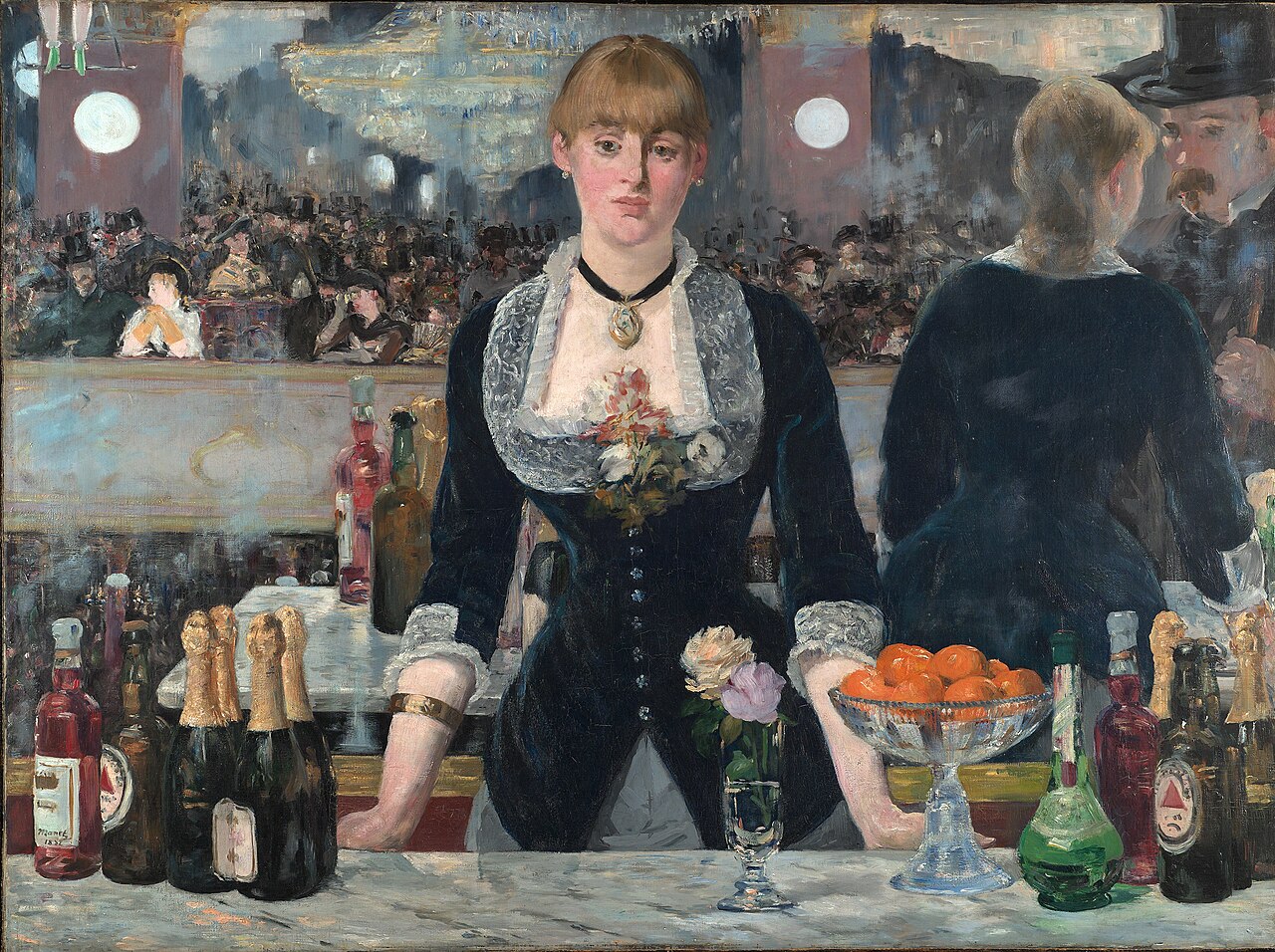 |
| A Bar at the Folies-Bergieres. Édouard Manet 1892
There are many interesting features of this painting that, despite it's late nineteenth century setting, make it quite modern. Firstly it is generally believed to be the first painting to depict a registered trade mark. Can you spot it? I will reveal it at the end of this article. Secondly there is the impossible composition; the girl behind the bar is looking straight out at the viewer of the painting yet, in the mirror behind her, her reflection can be seen talking to a customer at completely the wrong angle. For years I thought it was the back of another barmaid. The gent with the top-hat should be in front of us blocking our view. The girls name was Suzon, who in reality did work there, but Manet had painted her in his studio and added the background from quick impressionistic sketches he had made. She looks sad and detached from her work. She wears a locket around her neck which hints at a love far away from this world with the sinister stranger at the bar with his Jack-the-Ripper-like menace. This picture was painted immediately after The Ripper was 'active' (1888-91).
Eduard Manet worshipped the Spanish painter Diego Velazquez and his painting 'Las Meninas' is the surprising inspiration for this picture. Looking at the picture, below, can you see the connection and the elements that interested Manet? Let me explain:

'Las Meninas'. Velazquez 1656.
There is a strange mix of positions and points of view. The artist, the Infanta and a dwarf courtier are looking out of the picture at the viewer while others, within the painting, are interacting between themselves. Also reflected in a mirror, near the centre are what is probably the King & Queen who would be looking into the painting. Possibly they are the subject which the artist is painting. Shouldn't we be looking at their backs?
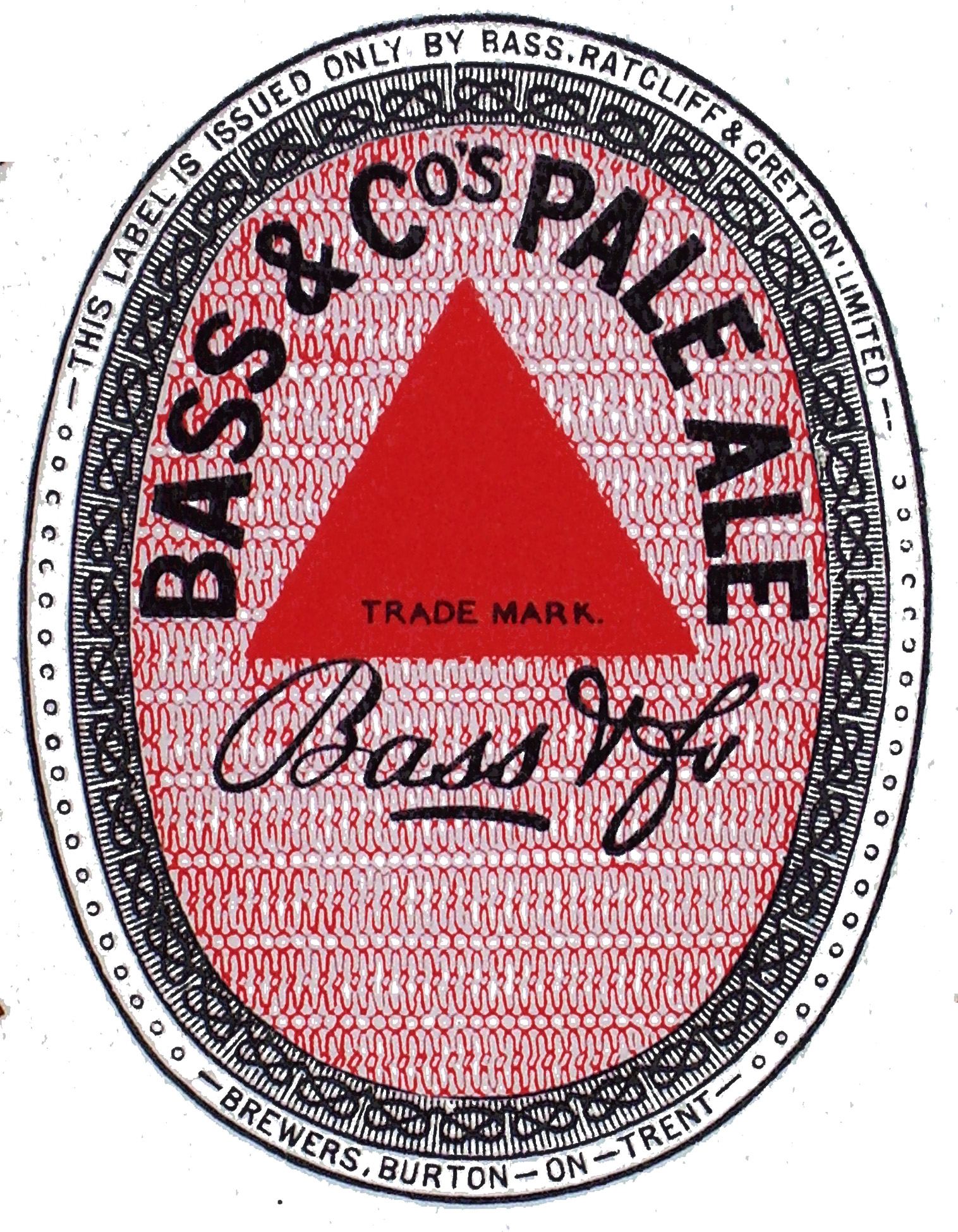
At each end of the bar is a beer bottle with a red triangle design on the label - the trade mark of Bass beer brewed in Burton-on-Trent, England. (Founded in 1777 and still going though not a patch on the great beer that it once was since being taken over by Anheuser-Busch!)
|
Listening to Negro Y Azul (The ballad of Heisenberg) by Los Cuates de Sinaloa from Breaking Bad. Fab! Listen here
Saturday, 29 November 2014
My Heroes (40): Roger McGough
I went recently, with my younger daughter, Laura, to hear the Liverpool poet Roger McGough reading works from his long career. In the 1960's he used to be in the band Scaffold with Paul McCartney's brother, Mike.
It was in our local library with a small audience and it was a very entertaining evening, both funny and moving by turns. I bought a few books and told him that the last one of his that I bought was as a teenager - many years ago. He looked at me over the top of his glasses with mock horror! He still has an element of that Liverpool wit, long associated with The Beatles.
 |
| Roger McGough now..... |

....and then, left.
Here are a few of his poems to enjoy:
GOODBAT NIGHTMAN
God bless all policemen
and fighters of crime,
May thieves go to jail
for a very long time.
They've had a hard day
helping clean up the town,
Now they hang from the mantelpiece
both upside down.
helping clean up the town,
Now they hang from the mantelpiece
both upside down.
A glass of warm blood
and then straight up the stairs,
Batman and Robin
are saying their prayers.
and then straight up the stairs,
Batman and Robin
are saying their prayers.
* * *
They've locked all the doors
and they've put out the bat,
Put on their batjamas
(They like doing that)
They've locked all the doors
and they've put out the bat,
Put on their batjamas
(They like doing that)
They've filled their batwater-bottles
made their batbeds,
With two springy battresses
for sleepy batheads.
made their batbeds,
With two springy battresses
for sleepy batheads.
They're closing red eyes
and they're counting black sheep,
Batman and Robin
are falling asleep.
and they're counting black sheep,
Batman and Robin
are falling asleep.
MAFIA CATS
We're the Mafia cats
Bugsy, Franco and Toni
We're crazy for pizza
With hot pepperoni
Bugsy, Franco and Toni
We're crazy for pizza
With hot pepperoni
We run all the rackets
From gambling to vice
On St Valentine's Day
We massacre mice
From gambling to vice
On St Valentine's Day
We massacre mice
We always wear shades
To show that we're meanies
Big hats and sharp suits
And drive Lamborghinis
To show that we're meanies
Big hats and sharp suits
And drive Lamborghinis
We're the Mafia cats
Bugsy, Franco and Toni
Love Sicilian wine
And cheese macaroni
Bugsy, Franco and Toni
Love Sicilian wine
And cheese macaroni
But we have a secret
(And if you dare tell
You'll end up with the kitten
At the bottom of the well
(And if you dare tell
You'll end up with the kitten
At the bottom of the well
Or covered in concrete
And thrown into the deep
For this is one secret
You really must keep.)
And thrown into the deep
For this is one secret
You really must keep.)
We're the Cosa Nostra
Run the scams and the fiddles
But at home we are
Mopsy, Ginger and Tiddles
Run the scams and the fiddles
But at home we are
Mopsy, Ginger and Tiddles
Lastly, to show that there can be depth as well as humour.....
YOU AND I
I explain quietly. You
hear me shouting. You
try a new tack. I
feel old wounds reopen.
You see both sides. I
see your blinkers. I
am placatory. You
sense a new selfishness.
I am a dove. You
recognize the hawk. You
offer an olive branch. I
feel the thorns.
You bleed. I
see crocodile tears. I
withdraw. You
reel from the impact.
hear me shouting. You
try a new tack. I
feel old wounds reopen.
You see both sides. I
see your blinkers. I
am placatory. You
sense a new selfishness.
I am a dove. You
recognize the hawk. You
offer an olive branch. I
feel the thorns.
You bleed. I
see crocodile tears. I
withdraw. You
reel from the impact.
Continuing my new
experiment of naming the music I am listening to while posting or commenting -
right now it's: Dissatisfied Blues by Brownie McGhee. Listen on You Tube: https://www.youtube.com/watch?v=29i6aMOIqLQ
Thursday, 13 November 2014
Painting of the month (50) November 2014: Bazza
To celebrate my 50th Painting of the Month post I am featuring an obscure artist known as Bazza of Redbridge. He is a watercolour specialist and this is a retrospective of some earlier works including some quick holiday sketches - one of his favourite ways of working. The paintings vary in size from postcard to A4.
 |
| 15 minute flower study |
 |
| Painted for my Grandson, Sonny ,when he had cancer at the age of five. |
 |
| Copied from a small picture in a holiday flat. |
 |
| The Beach Huts |
 |
| Some chap in a fantasy library with a Cezanne forgery on display. |
 |
| Sonny about a year after leaving hospital, aged six. |
 |
| Quaint local Street, Woodford Essex, UK |
 |
| Carvoiero, The Algarve, Portugal |
 |
| Carvoiero, The Algarve, Portugal |
 |
| English rural scene. Composed from an amalgam of three separate photographs. |
Thursday, 6 November 2014
The Boroughs of London (3): Bexley
When I chose the London Boroughs as the topic for this series I should have thought it through a bit more. It should have been called 'A Review of Some of the More Interesting and Historical London Boroughs'. Bexley would not have been on that list! However, I have often said that, if one keeps digging, something interesting can be found about almost any topic......
 |
| The London Borough of Bexley shown in green in the south-east of London, just south of the Thames. |
The village of Bexley, after which the Borough is named, has a charter dating from 834 but hardly any other local places are mentioned in the 11th century Domesday Book. It didn't really start growing quickly until the 17th century and the development of the railways in the 19th century was a major impetus for growth. It still has a tremendous amount of green open spaces. The population now is around 237,000 blah, blah, blah.
The most important building is Hall Place, which is Grade 1 listed and a Scheduled Ancient Monument. It was formerly a private stately home but is now owned by the local authority and houses a museum and several galleries. I don't know for sure but I bet it's available for wedding receptions.
 |
| Hall Place built around 1540. The second wing, on the right, was added about 100 years later. I don't think you could say that the architecture is sympathetic to the original building. 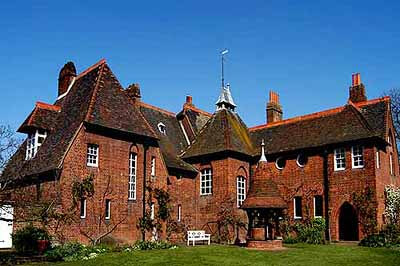
Bexley is also renowned for being the location of the only house built by and lived-in by William Morris, founder of the 19th century Arts and Crafts movement.
Located at Bexleyheath, the house is uniquely built of striking red brick. It is now owned and run by the National Trust and open to the public. And, big surprise, it has a tea room! The house is a fabulous example of one man creating his own dream home. He was not the architect but he put in plenty of ideas including hanging paintings by Edward Burne Jones. There is also a very charming garden where one can stroll and imagine what it must have been like to live there.
I knew I would find something interesting there!
Next in this series: The London Borough of Brent, home of Wembley, the national football stadium.
Continuing my new
experiment of naming the music I am listening to while posting or commenting -
right now it's Bette Midler singing 'Buckets of Rain' duetting with the writer of the song, Bob Dylan.
|
Subscribe to:
Posts (Atom)