| Kenneth Branagh as Macbeth
A brief description of the background to this play is important and relevant. King James VI of Scotland became James I of England and Scotland when the two nations were united in 1603 and William Shakespeare's company of players wisely became known as The King's Men instead of the The Queen's Men. They depended upon a certain amount of Royal patronage so when Macbeth was written, probably in 1606, it was natural that he wanted to please the new King.
James was known to have been a believer in Witchcraft and had actually written a book on the subject. Our William was rather clever in making the witches central to the Macbeth's tragedy. You are probably aware of the famous opening scene with the three witches. Click here to view that opening scene. The witches occur at intervals throughout the play.
Here is a brief synopsis of the plot: At the outset of the play Macbeth and Banquo are shown as heroic generals who have bravely helped Scotland defeat two invading armies. When the witches predict that Macbeth will be King he is sceptical until the King promotes him to a high rank (Thane of Cawdor) so he begins to believe the prediction. The themes that develop are deception and the destructive power of unchecked ambition (through hallucinations and 'blood'). When King Duncan comes to stay at Macbeth's castle in Inverness Lady Macbeth (the original femme fatale?) persuades him to murder the King, which he does. He then decides that his friend Banquo is a rival so he kills him too.
However, at a feast hosted by the newly-crowned Macbeths, Banquo's ghost appears at the dinner table and Macbeth begins to loose his mind. He is eventually killed by MacDuff, whose family Macbeth has also had murdered.
Shakespeare's genius shows in his psychological insight (before psychology existed!) such as this scene where, on his way to murder King Duncan, Macbeth hallucinates about a dagger, "Is this a dagger I see before me?", brilliantly played by Sir Patrick Stewart (Captain Picard of Star Trek if you prefer). This speech is a superb example of Shakespeare's craft and, in this clip, I especially love the menace evoked by the wonderful background music that hovers behind Macbeth's soliloquy.
It is often not appreciated how much the English language owes to the creations of William Shakespeare. Here are just a few quotes that originated in The Tragedy of Macbeth.
"Fair is foul and foul is fair"
- The witches indicating that all is not as it seems in life.
"Nothing in his life became him like the leaving it"
- Malcolm's description of Macbeth's slaying of the traitor Macdonwald.
"Yet I do fear thy nature; it is too full of the milk of human kindness"
- Lady Macbeth fearing that her husband isn't evil enough!
"Double,double toil and trouble;
Fire burn and cauldron bubble."
And
"By the pricking of my thumbs,
Something wicked this way comes."
- The witches awaiting the arrival of Macbeth.
"Out damned spot!, out I say!"
- Lady Macbeth referring to blood on her clothing, while she is sleep-walking.
"She should have died hereafter;
There would have been a time for such a word.
Tomorrow, and tomorrow, and tomorrow,
Creeps in this petty pace from day to day
To the last syllable of recorded time, And all our yesterdays have lighted fools The way to dusty death. Out, out, brief candle! Life's but a walking shadow, a poor player
Told by an idiot, full of sound and fury,
Signifying nothing."
- Macbeth on hearing of the death of his wife.
Macbeth: "If we should fail?"
Lady Macbeth: "We fail.But screw your courage to the sticking-place and we'll not fail."
Finally, my favourite part of the play (and there are many contenders) is this:
Macbeth has asked the witches if all of their predictions will come true, will no-one defeat him? and they tell him:
"Macbeth shall never vanquished be until
Great Burnam Wood to high Dunsinane Hill
Shall come against him."and
"No man of woman born shall harm Macbeth."
Burham Wood is a small forest about five miles from Dunsinane Hill where Macbeth's castle is situated.
Naturally Macbeth is pleased to hear this declaring that his overthrow "can never be"
However when an English army of 10,000 men advances on Macbeth in support of the legitimate Scottish King, their general tells them to cut branches from the trees in the wood to camouflage themselves.
So, when a servant informs Macbeth that Burnham Wood is advancing on the castle, Macbeth becomes even more unhinged (well, wouldn't you?)
And at the end of the play when Macbeth is fighting MacDuff, he still believes himself to be invincible because "no man of woman born" can harm him.
But he is then in informed by MacDuff that he was "ripped from his mother's womb" (ie: came into the world by Caesarean section).....oops!

MacDuff kills Macbeth
If you would like to see a BBC production of the play click here
|
Friday, 31 January 2014
Macbeth
Macbeth or, in Gaelic, Mac Bethad, was King of Alba (Scotland) from 1040 to 1057 so he died almost a thousand years ago. Although this post is about William Shakespeare's play it is important to know that (1) Macbeth was a real person and (2) the play is, historically, very inaccurate.


Thursday, 23 January 2014
My Heroes (38): Django Reinhardt
 |
| Jean "Django" Reinhardt 1910-1953
Django Reinhardt led a colourful and romantic life. He was born in Belgium into a Romani (Gypsy) family and remained immersed in that culture all of his life. His father had changed the family name on his birth certificate from Weiss in order to avoid military conscription
He is regarded as the first European musician to make an important contribution to the world of jazz music. He formed the Quintette du Hot Club de France with the violinist Stephan Grapelli in 1934 and is considered to have been one of the greatest guitar players who ever lived.
Amazingly two of the fingers of his left hand were paralysed after a fire in the caravan he shared with his then wife at the age of 18! He re-learned his playing technique after the injury and was able to make use of those fingers in chord playing but not in solos thereafter.
I always find joy listening to his music; its so full of energy and the deceptively casual playing could only be the work of an absolute master.
Django was greatly influenced by American jazz records that he heard and referred to Louis Armstrong as "my brother". He was also one of the first people in France to recognise the brilliance of Charlie Parker and Dizzie Gillespie.
He died of a brain haemorrhage at the early age of 43.
I have a link to a great selection of his music below: Enjoy!

The Quintette du Hot Club de France
In this line up they were unsual in being an all-strings jazz band
Click here for Bouncin' Around Click here for Minor Swing Click here for Body And Soul |
Thursday, 16 January 2014
Pam Ayers, writer of comic verse
Pam Ayers is a quintessentially English writer of comic verse who, because she speaks with a lovely Oxfordshire accent and is sometimes thought of as a 'corny' comedienne is, to my mind, often under-rated. But I think that she is a gifted writer of comic verse. I don't know if she is much known outside of the UK which would be a pity. Here is one of her typical verses. You can hear her reading one of her poems in the link at the end of this post. I recommend it.
I'M GOING TO KILL MY HUSBAND by Pam Ayres
I am going to kill my husband, I have stuck all I can stick,
His constant criticising is getting on my wick.
He takes it all for granted, but tonight I can relax,
For the minute he complains, I shall whop him with the axe.
Yes, I’m going to kill my husband, I shall have him to be sure,
He’s never going to curse my navigation any more.
I drive him to distraction when I read a map, I know,
But tonight I’m going to drive him where he didn’t plan to go.
So when he starts haranguing me till I’m a nervous wreck,
Shouts and spits and rages till the veins swell in his neck.
As he grabs the map from me there’ll be no turning back,
I will calmly reach behind me and I’ll whop him with the jack.
I mean, he gets a cold and I’m supposed to sympathise,
And his sneezes shake the rafters and tears roll from his eyes.
He looks so woebegone, just like the back end of a bus,
And yet when I am ill he’ll tell me not to make a fuss.
It’s true, he’s got to go, you may not think I’ve got the right,
But he snores you see and I should know, I’m with him every night.
With a horrifying steady rhythm, whistle, snore and snort,
Well tonight he’s going to stay asleep for longer than he thought.
“Your honour, I confess, that with a satisfying thwack,
I hit him with the frying pan from seven paces back.”
The weapon was examined by the jury good and true,
It was all made up of women, and they all said,”After you!”
Click here for a wonderful, hilarious reading by Pam Ayres
Saturday, 11 January 2014
Painting of the Month (41) January 2014: Gericault
 |
| The Raft of the Medusa by Théodore Géricault 1791-1824 (Completed 1819, oil on canvas, approx 16 x 23 feet) This painting is possibly more interesting for it's non-art elements than for the art work itself. In 1818 Théodore Géricault was a young man trying to build an artistic reputation but the innovation of this work is that it depicted a recent, true event.'History painting' is a genre in art that was dominant from the sixteenth century. It was intended to have moral or didactic overtones and usually depicted stories from the Bible, mythology or literature. It was only history in the sense of having a story or narrative and usually depicts a certain single point from that narrative. These paintings were often very large and this one is on a larger-than-life scale. It was viewed as the most important genre at that time and seen as the pinnacle of an artist's career.
In 1816 the French frigate Méduse ran aground off the coast of Senegal. The story that followed was one of 15 survivors left on a hurriedly constructed raft after 13 days at sea experiencing starvation, dehydration and....cannibalism. There was political outrage because an inexperienced captain had been appointed through his good connections rather than his skill.
Géricault had conducted extensive research before starting to paint and had visited morgues to get the decaying flesh tones right. His scheme worked and the controversial first showing of this painting in Paris catapulted him to fame and it was soon shown in London with similar success. It greatly divided the critics some of whom did not want to be 'repelled' by a 'heap of bodies' and thought that this could not be art.
On the other hand he was praised (by others) for showing a negro at the focal point of the picture. The triangular composition raising upwards to the right indicating the hopes of the survivors as a distant ship is seen on the horizon. The ship didn't see them and passed by. I think I can just make out a tiny point on the horizon. Earlier studies for the painting do clearly show a large vessel .
There were ten survivors from the Méduse. Géricault died five years later at the young age of 32. His painting lives on as an icon of French Romanticism.
You can just about see the ship on the horizon in this detail.
|
Saturday, 4 January 2014
Phil Everly 1939-2014
The death last night of Phil Everly, the younger of the Everly Brothers duo, truly is the end of an era. The importance of their influence on the world of popular music is impossible to overstate. Pop, rock, folk and country music in general owe a huge debt to them and The Beach Boys and The Beatles in particular have both acknowledged the inspiration they received.
 |
| Phil Everly: Born January 19th 1939, died January 3rd 2014
Linda Ronstadt, said: "They had that sibling sound. The information of your DNA is carried in your voice, and you can get a sound with family that you never get with someone who's not blood-related to you. And they were both such good singers -- they were one of the foundations, one of the cornerstones of the new rock 'n' roll sound."
They had such perfect close harmony that their live performances were a delight. I saw them on stage several times, most notably their 'Reunion Concert' at The Royal Albert Hall in London in 1983. I was the only person in the audience whom I had never heard of; talk about star-studded! They retained their popularity much longer in the UK than in the USA and were frequent visitors here.
They spent their early years growing up in Shenandoah, Iowa where their parents had a musical show on the radio so Don and Phil started to learn their craft from an early age.
There are some relevant links at the end of this post.
The Everly Brothers with Buddy Holly
Their many hits include:
Bye Bye Love; All I Have to Do Is Dream; Wake Up Little Susie; Poor Jenny; Take a Message to Mary; Bird Dog; When Will I be Loved; 'Til I Kissed You; Let It Be Me; Like Strangers; Cathy's Clown; So It Was, So It Is, So It Always Will Be; So Sad/Lucille; Walk Right Back; That's Old-Fashioned; Ebony Eyes; Temptation; Don't Blame Me; Crying In The Rain; The Price of Love; No One Can Make My Sunshine Smile; On the Wings of a Nightingale. There are many more.....
Of course our loss is as nothing compared to that of Phil's family and friends. His brother Don was reported as being unable to speak about it. Although they had a famous ten-year split, Phil once said that they were closer than most brothers are. Their lack of ego and show-biz behaviour coupled with their homely charm says a lot about them.
Don and Phil.....thank you.
|
Sunday, 29 December 2013
London Monopoly (20): Regent Street
Continuing my journey around the London version of the Monopoly board with Regent Street, the first property in the Green Set.
 |
| The beautiful curve of Regent Street seen as you enter from Piccadilly Circus, London |
Every one of the buildings in Regent Street is at least Grade II listed. This means that for Historical or Architectural interest no building can be altered or demolished without permission - which is usually not obtainable. Sometimes only the façade is protected and internal alterations can be made.
The street is one of the first examples of Town Planning as it cuts a swathe through the otherwise straight streets of the West One (W1) postcode. After the Great Fire of London, in 1666, there was a move to plan the reconstruction of the medieval city but it took one hundred and fifty years before this first attempt took place!
Named after the Prince Regent (later George IV) it was laid out by the great architect John Nash and completed in 1825. Now it is a high prestige shopping and business street in one of the most expensive parts of London.
.jpg/768px-Hamley's_(Regent's_Street_-_London).jpg) |
| Hamley's Toy Shop, Regent Street, London |
Hamley's,who style themselves
as "the world's most famous toy shop", have been in Regent Street since 1881 but were established in High Holborn, London in 1760 and there is a large Apple Store there too.
Regent Street is halfway through a 20 year £1 billion investment scheme and is continuously being improved and upgraded.
With 2 km of shop-fronts it rivals Fifth Avenue and the Champs Elysée for high prestige shopping.
Just as in the game of Monopoly, the rents in Regent Street are incredibly high.
 |
| The Apple Store, Regent Street, London
Wishing everyone who visits this site(about 100 unique visitors per day) a peaceful and preposterous (sic) 2014.
|
Saturday, 14 December 2013
Painting of the Month (40) Dec 2013: Grayson Perry
OK, so it's not a painting exactly but.....
 |
| JANE AUSTEN IN E17, GRAYSON PERRY(2009), MANCHESTER ART GALLERY |
This is a decorated vase made by the British artist Grayson Perry who, regrettably, is more well-known for his cross-dressing than for his art. It is titled 'Jane Austen in E17'. E17 is the first part of the unfashionable north-east London postcode of the artist's studio.
Perry will often juxtapose discordant themes and ideas and this example is typical. Obviously it is beautiful and appealing to the eye with it's depiction of genteel and elegant late eighteenth-century ladies carved into a Chinese style vase. However, a closer inspection will reveal the use of photo-printed images behind the ladies depicting contemporary violence in the local area of his studio.
 |
| DETAIL FROM THE ABOVE WORK |
The artist himself is a very interesting character. He is a married family man from the English county of Essex (same as me!) who has created an alter ego personality named Clare who is sometimes depicted in his artwork and provides a way for him to express certain facets of his life and personal history. Perry says that his female identity matches his low self-esteem because women are often seen as 'second-class' and so are potters, his chosen medium as an artist. Born in 1960, he came to public awareness after winning the important Turner prize in 2003 and this year (2013) he delivered the prestigious BBC Reith lecture series which was hugely enjoyable; he is a very open, honest and funny man. Definitely 'first class'!
 |
| GRAYSON PERRY |
 |
| GRAYSON'S ALTER EGO 'CLARE' |
Saturday, 30 November 2013
Sweet Thing
Another re-post from exactly three years ago. The years have not dimmed my love of this music......
Van Morrison: Sweet Thing
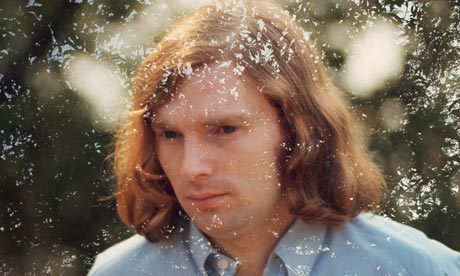 |
| http://www.last.fm/ |
(Click on the above to listen. Open another window if you want to listen and follow the lyrics!))
And I will stroll the merry way
And jump the hedges first
And I will drink the clear
Clean water for to quench my thirst
And I shall watch the ferry-boats
And they'll get high
On a bluer ocean
Against tomorrow's sky
And I will never grow so old again
And I will walk and talk
In gardens all wet with rain
Oh sweet thing, sweet thing
My, my, my, my, my sweet thing
And I shall drive my chariot
Down your streets and cry
'Hey, it's me, I'm dynamite
And I don't know why'
And you shall take me strongly
In your arms again
And I will not remember
That I ever felt the pain.
We shall walk and talk
In gardens all misty and wet with rain
And I will never, never, never
Grow so old again.
Oh sweet thing, sweet thing
My, my, my, my, my sweet thing
And I will raise my hand up
Into the night time sky
And count the stars
That's shining in your eye
Just to dig it all an' not to wonder
That's just fine
And I'll be satisfied
Not to read in between the lines
And we will walk and talk
In gardens all wet with rain
And I will never, ever, ever, ever
Grow so old again.
Oh sweet thing, sweet thing
Sugar-baby with your champagne eyes
And your saint-like smile....
Lyrics like poetry.......
"And you shall take me strongly
In your arms again
And I will not remember
That I ever felt the pain"
Van Morrison has a reputation as a grumpy old curmudgeon but with a body of work like he has nobody could seriously doubt his commitment to his art. Ever the contrary one, he say's 'it's just a job'! If you still doubt my word listen to 'Into The Mystic'.
"And you shall take me strongly
In your arms again
And I will not remember
That I ever felt the pain"
Van Morrison has a reputation as a grumpy old curmudgeon but with a body of work like he has nobody could seriously doubt his commitment to his art. Ever the contrary one, he say's 'it's just a job'! If you still doubt my word listen to 'Into The Mystic'.
Thursday, 14 November 2013
The Royal Parks of London (1) St James Park
 |
| A magical view across the lake in St James Park, London
St James Park is the second smallest of London's eight Royal parks at 57 acres. These parks were originally owned by the Crown and used for sport, mainly deer hunting. In 1532 Henry VIII purchased some marshland owned by Eton College in an area that had formerly consisted of a female leper colony and pig farms and he enclosed it to create a hunting park on his door-step. Successive monarchs improved the park until Charles II, upon the restoration of the monarchy after the English Civil War, had the park laid out in the way he had seen in France during his exile. Today the park is pretty much as improved by the architect and landscape designer John Nash in 1827. It's full of the most charming range of trees, shrubs, flowers and wildlife.
In 1664 the Russian Ambassador presented a pelican to the Court of St James (any Ambassador or High Commissioner to the United Kingdom is officially "Ambassador to the Court of St James") this began a tradition of presenting pelicans as gifts and today there is an island of rocks in the lake, especially for them. There are also Egyptian geese, Greylags, Wood Ducks and many other beautiful birds. At one end of the park is Horse Guards Parade famous for the ceremony of Trooping the Colour and at the other end the best view of Buckingham Palace is to be seen.
 |

Thursday, 7 November 2013
London Monopoly (19) Picadilly
I am resuming my journey around the London Monopoly board with Piccadilly - last of the properties in the Yellow set.
 |
| Piccadilly, looking towards Hyde Park Corner
Piccadilly runs east to west from Piccadilly Circus to Hyde Park Corner and is one of London's widest and straightest thoroughfares. It was once full of great mansions and houses and was formerly known as Portugal Street. A wealthy merchant named Robert Baker had a business there from the late 1500s making the lace collars called Piccadills which were fashionable at that time. It is reasonable to suppose that is the origin of the name it acquired in the 17th century although there are several competing theories.
At one time Piccadilly was known as "the most famous street in the world". It is now mostly famous for being the location of the Ritz Hotel and Fortnum & Mason the very posh grocery store and restaurant complex.
|
 |
| Piccadilly Circus with the statue of Eros
Situated at the epicentre of London's West End, Piccadilly Circus was always regarded as being at the very centre of the British Empire. As well as being a major crossroad it is also the metaphorical crossover point of the arts and of popular culture. It is surrounded by theatres and high-end architecture. It is an area that is always packed with tourists and students from around the world.

The statue of Eros is also known as the Shaftesbury Memorial as it was erected in 1893 in memory of the philanthropist Lord Shaftesbury. The base is made of cast bronze but, somewhat surprisingly, the statue itself is made of aluminium - a rare and precious metal at that time.
Next in this series: Regent Street.
I will not be going to Jail. Probably.
|
Friday, 18 October 2013
E. Annie Proulx
Here's another repost from October 2006:

Annie Proulx (pronounced 'Proo') is a writer of wonderful fiction. Her densely written, observational style is packed with lots of detail and a very strong sense of place, such as the unfashionable parts of Newfoundland, Wyoming and Texas. Her descriptive writing always reminds me of John Steinbeck's work due to her obvious affection for the places and kinds of people who are not usually the heroes of modern fiction. She has a Dickensian knack of naming her characters in an outlandish way that very soon seems to be perfectly na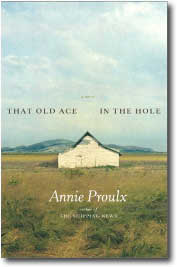 tural.
 tural.
For example “That Old Ace in The Hole” (2002) features, among others, Jerky Baum, Pecan Flagg, Blowy Cluck, Coolbroth Fronk, and Waldo Beautyrooms. It’s the story of Bob Dollar, hired by Global Pork Rind to buy up small farms, in the Texas panhandle town of Woolybucket, so that they can be turned into hog farms under the guise of buying land for luxury housing. The book touches on the larger issue of pollution and depletion of the water table as a background. The story is fairly thin on plot but rich in character and anecdote.
“Accordion Crimes” (1996) lovingly tells the story of a succession of owners of an accordion. Annie Proulx is a dispassionate observer of life but she does not shy away from unpleasant scenes and can be brutally honest in her depiction of those who are the losers in life’s lottery.
“The Shipping News” (1993) is a magnificent novel that demands a lot from the reader, whose attentiveness will be richly rewarded. At the start of each chapter a picture of a different type of knot is shown and this turns out to have a metaphorical reference to the content of that chapter. It was turned into a s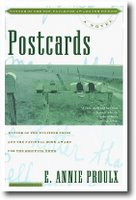 uccessful movie with Kevin Spacey in 2001. In a similar way “Postcards”(1992) showed a drawing of a postcard at the start of each chapter with a message that was sometimes directly relevant to the story and sometimes just added background colour. In 1997 she wrote a short story which was published in a collection of her work called "Close Range: Wyoming Stories" (1999) which was filmed in 2005. That was the very successful "Brokeback Mountain", in which she typically tackled a subject that had hitherto been taboo in mainstream literature.
“Accordion Crimes” (1996) lovingly tells the story of a succession of owners of an accordion. Annie Proulx is a dispassionate observer of life but she does not shy away from unpleasant scenes and can be brutally honest in her depiction of those who are the losers in life’s lottery.
“The Shipping News” (1993) is a magnificent novel that demands a lot from the reader, whose attentiveness will be richly rewarded. At the start of each chapter a picture of a different type of knot is shown and this turns out to have a metaphorical reference to the content of that chapter. It was turned into a s
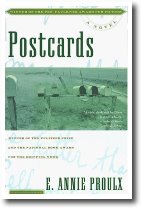 uccessful movie with Kevin Spacey in 2001. In a similar way “Postcards”(1992) showed a drawing of a postcard at the start of each chapter with a message that was sometimes directly relevant to the story and sometimes just added background colour. In 1997 she wrote a short story which was published in a collection of her work called "Close Range: Wyoming Stories" (1999) which was filmed in 2005. That was the very successful "Brokeback Mountain", in which she typically tackled a subject that had hitherto been taboo in mainstream literature.
October 2013 update: As far as I can determine she has only published 'Fine Just The Way It Is' (2008) since my original post.
Saturday, 12 October 2013
High Flight
As I have not posted for a while due to time restraint I have decided to work my way back to Blogging by reposting some of my favourite previous posts. This one is from my former Blog in 2006.
High Flight
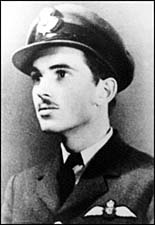 John Magee was born in Shanghai, China where his English mother and American father were missionaries. He was educated in England, became a US citizen and learned to fly in Ontario, Canada. He joined the Royal Canadian Air Force and was sent to England before the USA had entered the war. He became a Spitfire pilot and his love of flying is abundantly obvious in this poem which makes me feel as though I were flying when I read it. It was written on the 3rd of September 1941.
High Flight by John Gillespie Magee Jr.
Oh! I have slipped the surly bonds of earth,
And danced the skies on laughter-silvered wings;
Sunward I've climbed, and joined the tumbling mirth
Of sun-split clouds, --and done a hundred things
You have not dreamed of --Wheeled and soared and swung
High in the sunlit silence. Hov'ring there
I've chased the shouting wind along, and flung
My eager craft through footless halls of air...
Up, up the long, delirious, burning blue
I've topped the wind-swept heights with easy grace
Where never lark or even eagle flew --
And, while with silent lifting mind I've trod
The high untrespassed sanctity of space,
Put out my hand, and touched the face of God.
And danced the skies on laughter-silvered wings;
Sunward I've climbed, and joined the tumbling mirth
Of sun-split clouds, --and done a hundred things
You have not dreamed of --Wheeled and soared and swung
High in the sunlit silence. Hov'ring there
I've chased the shouting wind along, and flung
My eager craft through footless halls of air...
Up, up the long, delirious, burning blue
I've topped the wind-swept heights with easy grace
Where never lark or even eagle flew --
And, while with silent lifting mind I've trod
The high untrespassed sanctity of space,
Put out my hand, and touched the face of God.
The poem is allegedly derivative of several earlier works by other writers but nevertheless stands up as a masterpiece of a description of flying. Three months after writing this poem, in December 1941, he was killed in his Supermarine Spitfire in an accident over Lincolnshire, England. Incredibly, he was nineteen years old.
Saturday, 8 June 2013
London Monopoly (18): Coventry Street
This is the second property in the 'Yellow' set on my tour of the London Monopoly board.
 |
| The Prince of Wales Theatre, Coventry Street, London
Coventry Street is situated in the heart of London's West End connecting Trafalgar Square to Piccadilly Circus. The street is fairly unremarkable but, as is often the case, there is something interesting to say about it. Currently it is where the Prince of Wales Theatre is situated and that's where the hottest ticket in town will get you in to see The Book of Mormon, "God's favourite musical".
It is also the location of the famous Café de Paris which since the twenties was the home of stars and royalty. Cole Porter was a regular and would often try out his new songs there. It was also a favoured haunt of Frank Sinatra, Marlene Dietrich, Grace Kelly and many others. In March 1941 a huge German bomb came through four floors of heavy masonry and killed over thirty people. Perhaps the best-known victim of the Café de Paris bombing was the musician, Ken 'Snake-hips' Johnson. His parents had sent him from the then colony of British Guiana in 1929 because they had hopes of him becoming a doctor and they wanted him to have a British education. Somehow, I find individual stories more moving than that of mass killings.
These days it is renowned for the various flamboyant night-club evenings where the 'ladies' seem to have some grey stubble and rather deep voices.
|
 |
| Two views of the luxurious Café de Paris interior as it is today |
 |
In the 1890s a French bookseller called Charles Hirsch had a shop there which became infamous as a source of homosexual pornography, (the word 'gay' had a different meaning then). Apparently Oscar Wilde was regular customer. Goodness what a portrait of London I am painting! I suppose that will be appealing or appalling according to your bent.....I say live and let live.
|

Tuesday, 14 May 2013
Painting of the Month (39) May 2013: Dong Kingman
I am marking my resumption of this Blog with a series of watercolours by Dong Kingman, 1911-2000, one of my favourite watercolour artists. He was a Chinese-American painter in the style of the California School ("The California Style of watercolor painting which flourished from the mid-1920's to the mid-1950's gave the traditional watercolor medium a bold new look.This new representational art, defined by a large format, free broad brush strokes, and strong rich colors, documented scenes and activities of everyday life on the Pacific Coast. California's cities and industrial sites, its beaches and harbors, and its vast open landscapes were interpreted by hundreds of artists using innovative new approaches to watercolor painting". www.calart.com)
You can double-click the pictures for a better view
 |
| 442 Combat Team at Leghorn 1976. I like the use of leaving parts of the paper white to convey bright sunlight. |
 |
| I can't find any information about this picture but I really like the use of vivid colour and the simplicity of the design. |
 |
| Rickshaws Under a Tree There is a strong Chinese influence (apart from the obvious subject matter) visible here. |
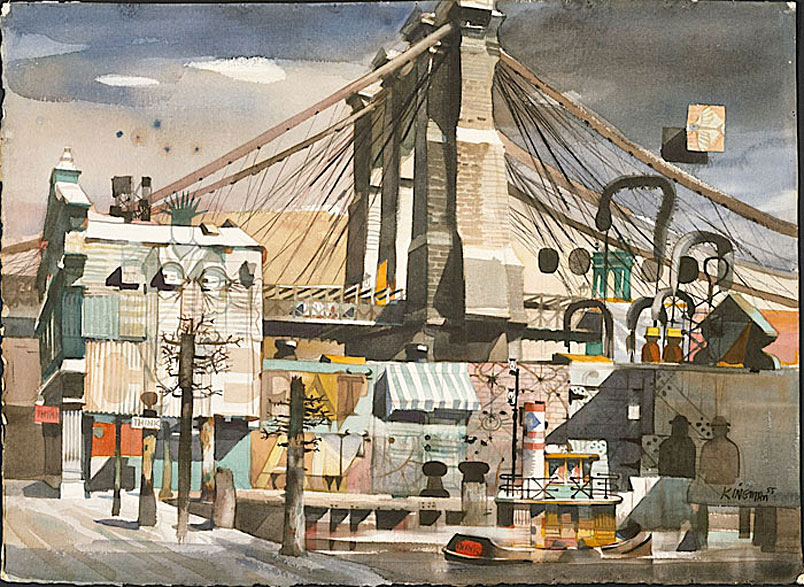 |
South Street Bridge 1955.
Kingman worked in the film industry and many of his images appear to be on film-set locations. Sometimes cine equipment can be seen in the paintings. I'm not sure if that applies here but it definitely can be seen in the final picture below.
Four Men on a Bicycle
For me, these paintings convey the pure joy of simply looking at them!
|
Saturday, 16 March 2013
I'm Taking a Short Break from Blogging........
 |
| An English country garden. Something nice to remember this Blog by! |
......but I enjoy it too much to stay away for long! I have been a bit busy lately (in a positive way) and have been a bit pressed for time. I'll be back soon - watch this space.
Sunday, 3 March 2013
Painting of the Month (38) March 2013: Cezanne
 |
| Paul Cezanne: Still Life with Plate of Cherries, 1885-1887
I like this painting very much but it is not a great painting. I think it is very interesting because it says something important about the place of Paul Cezanne in modern art.
The first thing you may have noticed is that the two plates appear to be sitting on different planes. That is to say that the plate of cherries looks as though it has been tipped-up and we are viewing it from a slightly different angle than the plate of peaches and the vase behind them.
A generation earlier this would have been unthinkable and would have seemed to be incompetence but Cezanne knew exactly what he was doing. From a modern perspective he can be seen as a link between the Impressionists (he is generally labelled as a Post-Impressionist) and the Cubists. He was interested in binocular vision, wherein a separate image from each eye is combined to make one vision but, as we all know, if one closes alternate eyes two different views will be seen. He was also interested in seeing everything in nature as cones, spheres and cylinders. He later began to break the picture surface up into shapes. See, for example the picture below, completed in 1906, where he is experimenting with shape.

Picasso and Braque further developed these ideas and, between them, founded the Cubist movement with multiple view-points being a distinguishing feature. Picasso and Matisse acknowledged that Cezanne "is the father of us all".

Pablo Picasso, 1909
I think the influence that Cezanne had on Matisse was as a colourist. Colour was always an important feature of Cezanne's output and Picasso himself acknowledged Matisse's superiority in that departrment.
|
Subscribe to:
Posts (Atom)