 | ||
| Washington Crossing the Delaware, Emanuel Leutze, 1851 The Metropolitan Museum of Art, Public Domain,
My American
friends will have to excuse this Brit for writing about what is possibly the
most famous of American paintings. Emanuel Leutze, 1816 – 1868, was a
German-American ‘History Painter’; History painting was at the summit of the hierarchy
of genres, meaning that it was considered the most important because, to paraphrase
Samuel Johnson, it required all of the skills that were needed for all other
types of painting. This painting was completed
in 1851, around the time that those
hierarchies were starting to become less important. In keeping with the genre, it is of a
monumental size, measuring more than 12ft by 21ft., (3.78 by 6.47m). He started
to paint the picture in 1849 but it was damaged by a fire in his studio in
1850. It was restored only to be destroyed in Berlin in 1942 by a bombing raid.
He did, however, make at least two copies and many other artists have copied
and pastiched this painting.
I think it
is a very beautiful picture which has been executed with great skill. There are
various inaccuracies and ‘impossibilities’ of which it may seem petty of me to
mention. However, it won’t stop me because they are all interesting points.
Firstly, the man standing on Washington’s right (who is James Munroe, a future
President), is holding the Stars and Stripes flag which did not exist as such until
well after this depiction – on the dawning of 26th December 1776.
The Delaware is much narrower than depicted here at that crossing point and
when it freezes over it tend to be in sheets, not chunks as depicted. The
artist used images of the Rhine to create the river, where the ice does form chunks. Incidentally,
Washington was leading a surprise attack on the Hessian troops based in
Trenton, New Jersey, who were German mercenaries employed by the British; they
formed fully 30% of British troops in the War of Independence!
The boats,
shown carrying a selection of ‘types’, eg. a Scotsman, a Negro, a Frontiersman
etc, are of the wrong kind with sides that are much too low. The light is all
wrong, appearing to come from several different directions at once. Also, Washington,
reasonably enough, is shown in an heroic pose but would not have been able to
stand up like that. None of this matters much- it is a magnificent piece of
work which creates real depth by the way in which the background boats are
spread into the distance and one can almost reach out to touch the ice-chunks.
I'm listening to Carole King singing her own song, "I Wasn't Born to Follow" made famous by The Byrds but I love her version best! |
Tuesday, 9 August 2016
Painting of the Month (64) August 2016: Leutze


Saturday, 30 July 2016
Abbey Road Studios
 |
| The Abbey Road Studios and that crossing, St John's Wood, London |
The Abbey road studios in north-west London are, of course, famous for being the place where the Beatles recorded nearly all of their singles and albums but it has an interesting story of it's own to tell.
Firstly a brief bit of historical background: In the year 1130 Kilburn Priory was established for a community of nuns and lasted until the Dissolution Of the Monasteries in 1537 by Henry VIII. The property at number 3 Abbey Road was originally a nine-bedroom Georgian private townhouse built in 1830 on the lane that lead to where the priory had once stood. There was never an abbey as such but the road was so-named after the religious community. The building is now an English Heritage Grade II Listed Building - for historical rather than architectural reasons. Incidentally, it might be of interest to British readers to know that the Abbey National, now part of Santander, was founded in Abbey Road in 1874 as The Abbey Road & St John's Wood Permanent Benefit Building Society.
In 1931 The Gramophone Company bought the building and Sir Edward Elgar then conducted the recording of some of his own music. They soon combined with The Columbia Gramophone Company to form EMI. Many famous recordings of classical and popular music were made there over the years by artists ranging from Pablo Casals and Paul Robeson to Pink Floyd. George Martin, worked at Abbey Road from the 1950s mainly producing comedy records for people like Peter Sellars and Spike Milligan. Brian Epstein had tried in vain to get the Beatles signed to a record label but George Martin was the only one who saw something in them. After their first recording session he asked the Beatles if there was anything that they did not like. George Harrison said "Yes, your tie for a start!" and a rapport and a mutual admiration was formed which propelled the recordings and the band into a sensational world-wide phenomenon. On August 8th, 1969, at 11.35am the Beatles walked onto the pedestrian street crossing outside of the studios for a ten-minute photo session for the cover of their new album, Abbey Road.
 |
| Abbey Road, 1969 |
Now the crossing itself is also Grade II listed and is the most famous street-crossing the world. The studio and crossing has people from all over the world hanging around in awe all of the time. There is even a website where one can observe the scene, live on camera twenty four hours a day!
See: www.abbeyroad.com/crossing
(PS: OK, I just visited that camera and there is nobody around at 6:30 on a Sunday morning. So sue me!)
Finally an interesting footnote. The studios were actually named after the Beatles album, in 1970. Before that they were known as The EMI Studios!
 |
| Sir George Martin, 1926 - 2016 I'm listening to Revolver, my favourite Beatles Album |
Wednesday, 20 July 2016
Painting of the Month (63), July 2016: Gustav Klimt
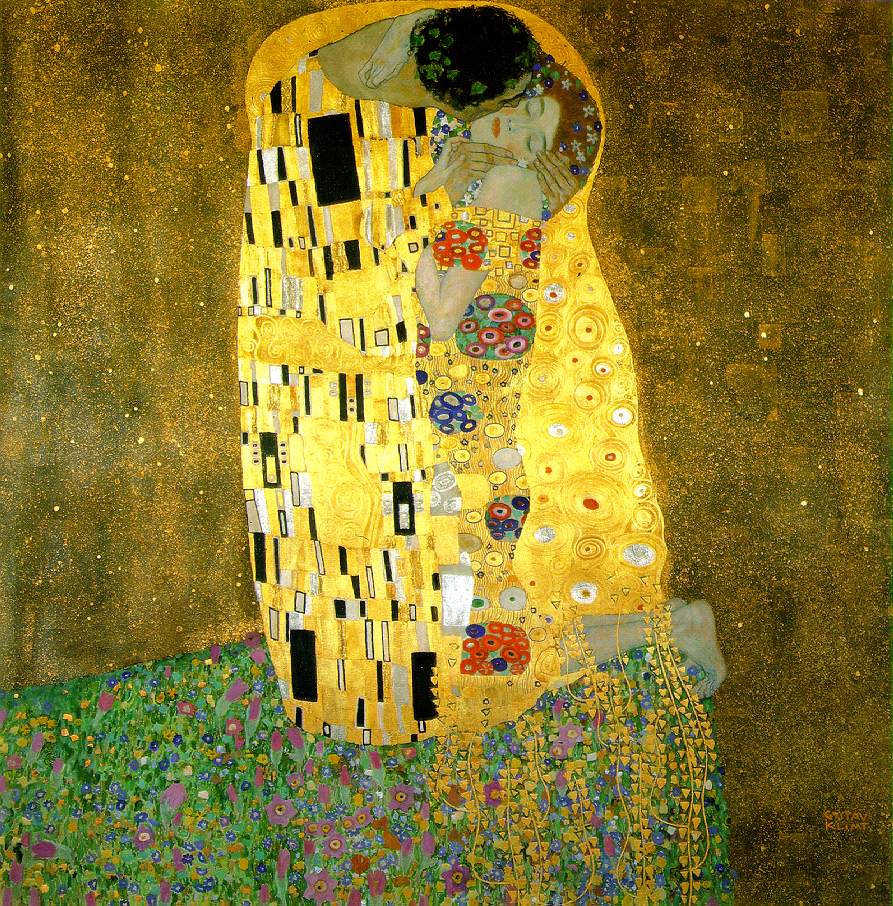 |
| The Kiss, Gustav Klimt, 1907-8, Österreichische Galerie, Vienna |
 He painted The Kiss in 1907-08 and it was a huge success being
sold before it was even finished for a fee much higher than the previous record
for an Austrian painting. It is now, beyond any doubt, one of the most iconic and
well-known pictures in the world. It’s a huge square painting measuring 1.8 metres,
or 6 feet, along each side, although it is often truncated to a rectangle for marketing purposes.
He painted The Kiss in 1907-08 and it was a huge success being
sold before it was even finished for a fee much higher than the previous record
for an Austrian painting. It is now, beyond any doubt, one of the most iconic and
well-known pictures in the world. It’s a huge square painting measuring 1.8 metres,
or 6 feet, along each side, although it is often truncated to a rectangle for marketing purposes.
Gustav Klimt was an Austrian Symbolist painter born in 1862 in Vienna.
Symbolism is the expression of an idea over a realistic description or
depiction of the natural world.
Like many great works of art it reflects a
collision of artistic styles. The prevailing style of
the day was Art Nouveau, characterised by intricate linear designs and flowing curves based on natural forms but
the simple form and bold patterns of their cloaks also shows influence of the organic
forms of the earlier Arts & Crafts movement.
A few years before creating this beautiful work
Klimt had seen the Byzantine mosaics in the San Vitale Church in Ravenna. He
was inspired by the use of gold-leaf and the flatness of the paintings and lack
of perspective which had the effect of making the gold seem to shimmer and
stand-out. He achieved a similar effect by combining gold-leaf and oil paint.
Other clear influences were the fin-de-siecle spirit of
sensuality and decadence. Also, I think it’s clear that Japanese painting had
an influence.

Sunday, 12 June 2016
'Poem' by Donald Justice
When I first read this poem I did not fully comprehend what was going on but I knew that I really liked it. Justice was a very experimental poet but also wrote in a wide variety of forms from formal, traditional to blank verse. It is paradoxical in many ways; the first line (which is repeated as the last line) states that the poem is 'not addressed to you', when clearly it is.
How should we deal with this? What is the poet saying to the reader?
 POEM by DONALD JUSTICE (1925-2004)
How should we deal with this? What is the poet saying to the reader?
This poem
is not addressed to you.
You may
come into it briefly,
But no
one will find you here, no one.
You will
have changed before the poem will.
Even
while you sit there, unmovable,
You have
begun to vanish. And it does not matter.
The poem
will go on without you.
It has
the spurious glamor of certain voids.
It is not
sad, really, only empty.
Once
perhaps it was so sad, no one knows why.
It
prefers to remember nothing.
Nostalgias
were peeled from it long ago.
Your type
of beauty has no place here.
Night is
the sky over this poem.
It is too
black for stars.
And do
not look for any illumination.
You
neither can nor should understand what it means.
Listen,
it comes without guitar,
Neither
in rags nor any purple fashion.
And there
is nothing in it to comfort you.
Close
your eyes, yawn. It will be over soon.
You will forge
the poem, but not before
It has
forgotten you. And it does not matter.
It has
been most beautiful in it’s erasures.
O
bleached mirrors! Oceans of the drowned!
Nor is
one silence equal to another.
And it
does not matter what you think.
This poem
is not addressed to you.
The last lines of Shakespeare's Shall I Compare Thee to a Summers Day are:
"So long as men can breathe or eyes can see,
So long lives this and this gives life to thee".
Justice makes a similar point, that the poem will not change over time ('You will have changed before the poem will') but the reader will. Poets usually form a relationship between themselves and the poem but in this case the reader is also involved, despite what the poem says.
I think he also says that the poem is not important (his poetry was often self-effacing): 'do not look for any illumination'. If we had said to the poet "Ah gotcha! If the poem is not addressed to me, why am I mentioned?", he might have riposted something akin to the answer in Monty Python: "I might be arguing in my own time!".
It's ironic that the poem is profound while claiming not to be ('There is nothing in it to comfort you'). One cannot help being drawn into it and seeking meaning!
Listening to The Doors singing 'Touch me' (it's on the radio!)
Friday, 3 June 2016
Painting of the Month (62) June 2016: Cimabue

Cimabue: Fresco in the Basilica di San Francesco, Assisi c.1278
The picture depicts the Madonna and Child with four Angels and St Francis
Sometimes
in art, as in life in general, greatness is soon eclipsed by a still superior
greatness. Cimabue (1240 - 1302) was the last great Byzantine painter
but his pupil Giotto is generally regarded as the first great painter of the
Italian Renaissance. Today the name of
Cenni di Pepi, known as Cimabue (pronounced as Cheema-boo-ay)
is barely known while the genius of Giotto is rightly recognised. The
characteristics of Byzantine painting were; an almost total concern with
religious expression, mainly icons; flatness and lack of perspective; often a
severe almost abstract other-worldly style was used and background and
highlights were of gold which had the ability to make a solitary figure appear
to be floating somewhere between the wall and the viewer. The intention was to
depict images of the divine that were raised above the mundane. Despite, or
possibly because of these restrictions, the art managed to convey
great beauty.
 |
| St Francis, detail |
It can be seen from the detail, left, that Cimabue was beginning to get some individual expression into the faces he painted. Before his time there was no individuality shown in portraits. It's important to realise that new styles in art don't just cut in with the suddenness of a banjo chord; Cimabue was a genuine link between Byzantine and Renaissance art. Little is known about his life although a few details are given in Vasari's Lives of the Painters (1550).
I'm listening to a cast recording of the 'American Tribal Love-Rock Musical' Hair. The current track is 'What a Piece of Work is Man', lyrics by W.Shakespeare. Listen here.
Tuesday, 24 May 2016
The Symbolism of Mermaids
 |
| Rembrandt |
Various myths and histories from around the world have featured mermaids and mermen for thousands of years. They were first recorded in about 1200 BC in Assyria and have featured in many ancient and modern stories since then. There were half-human sculptures of Babylonian fish-gods even hundreds of year prior to that. The ancient Assyrian goddess Atargatis was supposedly in love with a human shepherd-boy but accidentally killed him and, filled with remorse, she flung herself into the water hoping to become a fish. However, her great beauty prevented this happening but she became half goddess-half fish.
Famously, Christopher Columbus reported seeing mermaids on his transatlantic voyage; they are now thought to have been manatees which belong to group of animals known as Sirenia. 'Sirens' was the name given to the mythical creatures who lured sailors to their deaths with their songs which clearly has influenced later legends.
 |
| Frederic Leighton |
In 1614 Captain John Smith saw a mermaid from his ship she was 'swimming about with all possible grace'. In fact, Smith was so taken by this lovely vision that he began "to experience the first effects of love" (take that as you will) as he gazed at her before his sudden (and surely profoundly disappointing) realization that she was a fish from the waist down. This dilemma is reflected in a popular song titled "The Mermaid,"
"Cause her hair was green as seaweed
Her skin was blue and pale
I loved that girl with all my heart
I only liked the upper part
I did not like the tail'"
Mermaids represent many things symbolically in art: seduction, flirtation, beauty, divine feminine essence, the ocean, danger, provocation, treachery but possibly most of all unattainable love.
They have long been a popular subject in art and fiction. Hans Christian Anderson wrote The Little Mermaid in 1836 (there is a famous statue in Copenhagen harbour of the mermaid); the film Splash was a big hit in 1984. Although there is no actual real evidence of their existence, reports of sightings continue with 21st century reports from Zimbabwe and Israel. In 2009 Shlomo Cohen reported seeing a mermaid performing tricks off the coast of the town of Kiryat Yam. We have no knowledge of what kind of cigarettes Shlomo had been smoking......
 |
| John Reinhard Weguelin |
Greek mythology contains stories of the god Triton, the merman messenger of the sea, and several modern religions, including Hinduism and Candomblé (an Afro-Brazilian belief), worship mermaid goddesses to this day. Homer's Odyssey, written around 800 B.C., tells the story of Ulysses, whose ears were tortured by the sweet sounds of the sirens. In other legends, for example from Scotland and Wales, mermaids befriended and even married humans.
By the 1800s, hoaxers churned out faked mermaids by the dozen to satisfy the public's interest in the creatures. The great showman P.T. Barnum was well aware of the public's interest in mermaids and, in the 1840s, displayed the "Feejee Mermaid," which became one of his most popular attractions. People paying 50 cents hoping to see a long-limbed, fish-tailed beauty comb her hair were surely disappointed; instead, they saw a grotesque fake corpse a few feet long. It had the torso, head and limbs of a monkey and the bottom part of a fish. To modern eyes, it was an obvious fake,but it fooled and intrigued many people at the time.
Legends of mermaids may be ancient, but they are still present in many forms; their images can be found in films, books, movies and even Starbucks.
 |
| Starbucks Trademark featuring a Mermaid with a bifurcated tail. |
I'm listening to Nina Simone today. At this moment it's Don't You Pay Them No Mind. Listen Here. It's a great reminder of her artistry.
Monday, 16 May 2016
St James Park, London
St James is my favourite of London's Royal Parks. It's quite small at 57 acres and forms part of a green link from Westminster in the east to Kensington Gardens in the west. King Charles II wanted to be able to walk across London from Westminster without leaving Royal greenery. It is named after James the less, one of the twelve Apostles.

London is 40% green open space - the highest for a city of it's size and the sixth highest of any city.
One of the features of St James is the exotic wildlife, with many species of water-fowl including a small group of pelicans first given by the Russian Ambassador in 1664.
"A remarkable bird is the pelican.
It's mouth can hold more than its belican."
 |
| Pelicans in St James Park waiting for lunch! |
On Sunday we saw Ruddy Shellducks, Egyptian Geese, Pochard, Red-Crested Pochard, Mute Swan, a black Swan, Mandarin Ducks, Tufted Duck, Mallard, Smew, Coots, Grey Heron and many others which I couldn't identify. At dusk one can see Pipistrelle Bats.
Although the park is very pretty and associated with Royalty it has a dubious history particularly at night-time. John Wilmot, the Second Earl of Rochester (born 1647) was considered by many to be the greatest poet of the age. The reason that you probably have not heard of him is that much of his output was eye-wateringly pornographic. His most famous poem is "A Ramble in St James Park". I'm afraid that I can't quote any here but you can look it up online (which I have done in the interests of research!)
 |
A magical view of London from the bridge across the lake in St James Park Looking in the other direction with Buckingham Palace and the Victoria Memorial with the golden angel in view. |

The Welsh Guard of the Household Cavalry in the park

These red geraniums exactly match the colour of the Guards uniforms.

A view in the park with Buckingham Palace in the background.

Flower beds with Horse Guards Parade in the background
Listening to Etta James version of Stormy Weather. I think her version is as good as Ella Fitzgerald's. Listen here.
Saturday, 30 April 2016
Painting of the Month (61) April 2016: Wliiliam Hogarth
This painting is a part of William Hogarth's The Humours of an Election series. His paintings are still very popular today because many of the iniquities he portrayed can still be seen and felt around us.
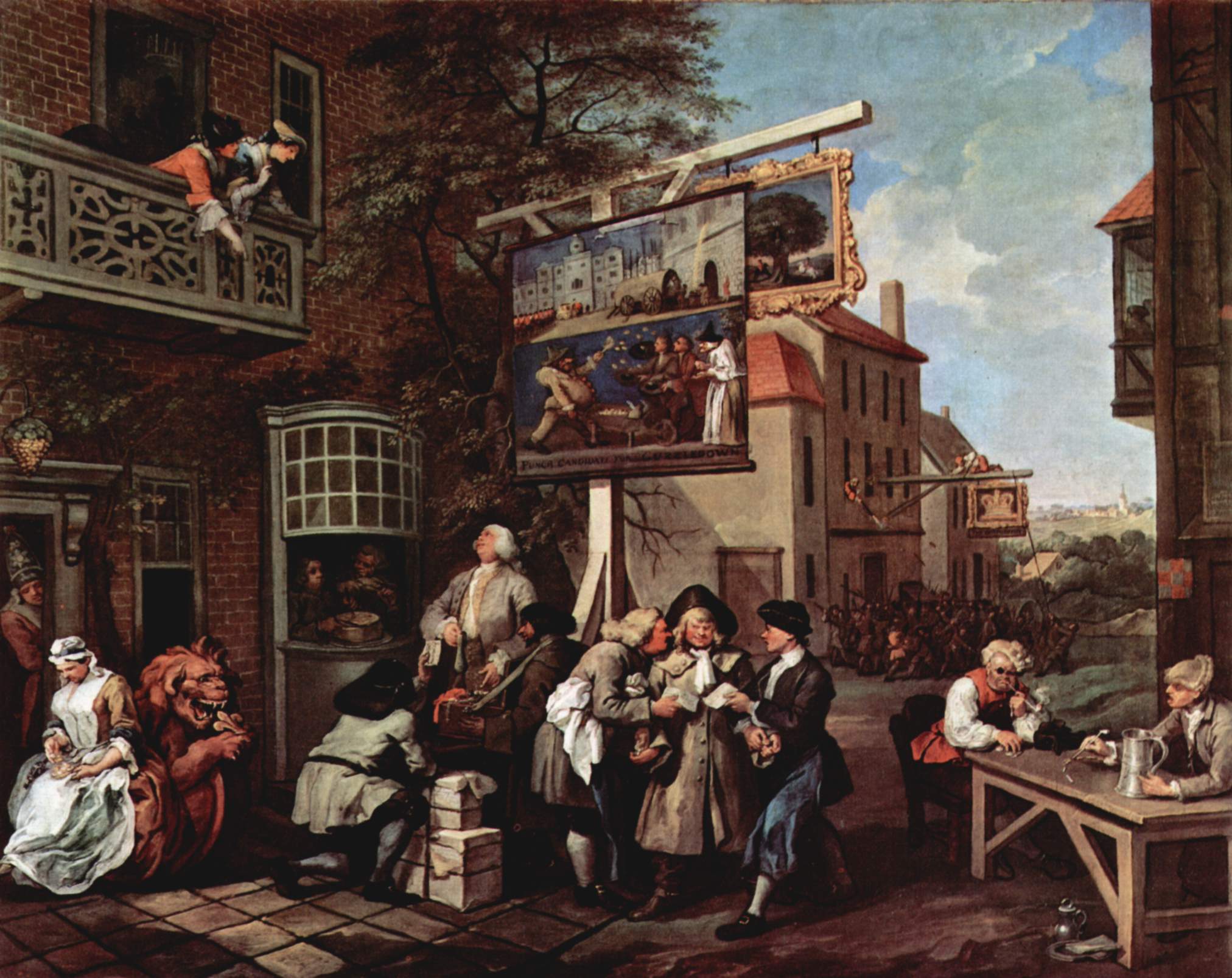 |
| Canvassing for Votes, William Hogarth, 1754, The Sir John Soane Museum, London |
Peering out from the doorway on the left is a soldier whose purpose is to represent uncorrupted patriotism. In front of him the British lion is devouring the fleur-de-lis of France. At the table on the right two old men, possibly sailors, are arguing about the Battle of Portobello in which the British fought the Spanish in Panama.
In the background a violent mob from one party are trying to destroy the headquarters of their rivals. A humorous note is the man sawing off the pub-sign unaware that he will fall when it does! Hogarth was an adequate and competent artist but this painting was made for satirical purposes exposing bribery & corruption and mob violence.
This series of oil paintings are on a massive scale, measuring five by seven feet; this really elevates them to the genre of 'History Painting'.
Listening to the British folk-singing duo, the formerly married couple, Richard and Linda Thompson's I Want to See the Bright Lights Tonight. Listen here.
Saturday, 23 April 2016
Answers to the self-portrait quiz.
Here are the results of the Self-Portrait quiz from my previous post.I have tried to show two self portraits or one plus two photographs, if possible, in each case.
Clearly, the winner was David in a difficult quiz buts there were many good answers as well.


Clearly, the winner was David in a difficult quiz buts there were many good answers as well.


Saturday, 16 April 2016
Bazza's Self-portraits Quiz
Here are twenty self-portraits; they are all made by people from 'the arts' in general, not necessarily known as painters and one answer appears twice. How many can you name? Answers in about a week's time. No prizes other than the kudos of winning one of Bazza's quizzes! Come on, have a go!

I'm listening to Matching Mole; (Robert Wyatt will shortly feature in a post).
This is a sad story from real life:
Listen to O'Caroline here.
This is a sad story from real life:
Listen to O'Caroline here.
Thursday, 24 March 2016
Painting of the Month (60): John Yardley
John Yardley is a British watercolour painter born in 1933.
I really like his work for it's economy and expressions of sunlight on streets and buildings.
For me this painting is all about "less is more". At first glance it appears to be a quick sketch but it is masterly in it's use of paint with economy - it's certainly not overpainted. It conveys a very pleasant evocation of sunlight and a little piece of a private domestic space. Yardley often uses the white of the paper to convey sunlight, but not here. The dark shadows also help to point to brightness.
Who wouldn't like to come home to this scene? It's on sale at £1,900 and, believe me, I would if I could!
I really like his work for it's economy and expressions of sunlight on streets and buildings.
 |
| "The Terrace", John Yardley, watercolour on paper, 14 x 20 inches |
Who wouldn't like to come home to this scene? It's on sale at £1,900 and, believe me, I would if I could!
I'm listening to Small Town Talk by Bobby Charles. You can listen here.
Tuesday, 1 March 2016
The Listeners by Walter de la Mare
I learnt this poem at
school, probably aged about 12, and it has stayed with me for all my life. It
was first published in London in 1912. I only recently began to ask myself why
but now I can see that it must have fired my imagination. It paints a picture
of a singular incident in a moment of time. As a child I imagined the traveller
to be a knight in armour and the building to be a ruined castle - now I can see
that the great success of this poem is that one could make many varied
interpretations of it. I will discuss it further after you have read it!
THE LISTENERS by Walter de la Mare
‘Is there anybody there?’ said the Traveller,
Knocking on the moonlit door;
And his horse in the silence champed the grasses
Of the forest’s ferny floor:
And a bird flew up out of the turret,
Above the Traveller’s head:
And he smote upon the door again a second time;
‘Is there anybody there?’ he said.
But no one descended to the Traveller;
No head from the leaf-fringed sill
Leaned over and looked into his grey eyes,
Where he stood perplexed and still.
But only a host of phantom listeners
That dwelt in the lone house then
Stood listening in the quiet of the moonlight
To that voice from the world of men:
Stood thronging the faint moonbeams on the dark stair,
That goes down to the empty hall,
Hearkening in an air stirred and shaken
By the lonely Traveller’s call.
And he felt in his heart their strangeness,
Their stillness answering his cry,
While his horse moved, cropping the dark turf,
’Neath the starred and leafy sky;
For he suddenly smote on the door, even
Louder, and lifted his head:—
‘Tell them I came, and no one answered,
That I kept my word,’ he said.
Never the least stir made the listeners,
Though every word he spake
Fell echoing through the shadowiness of the still house
From the one man left awake:
Ay, they heard his foot upon the stirrup,
And the sound of iron on stone,
And how the silence surged softly backward,
When the plunging hoofs were gone.
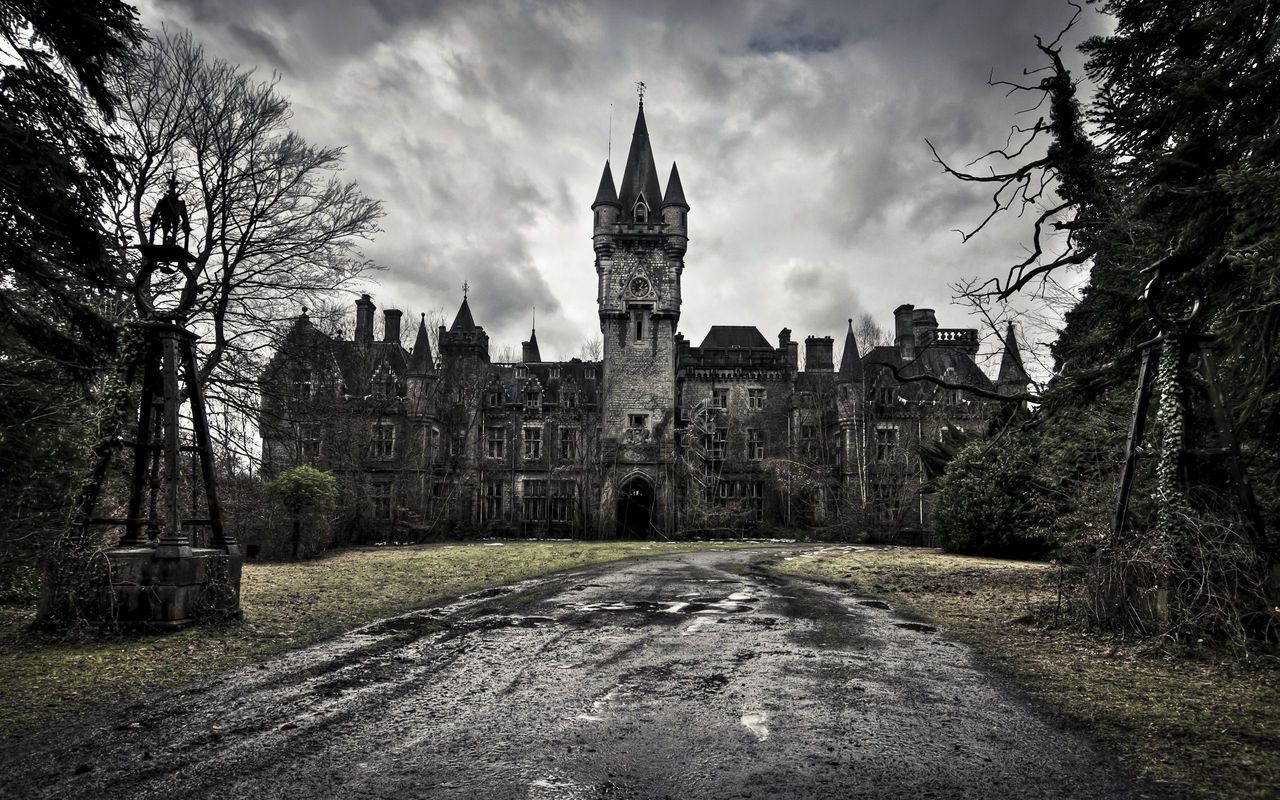
I like the air of mystery that the
poem creates. Who was the rider? Why was he knocking on the door of a seemingly
abandoned building? Who were ‘they’ who
should be told that he had arrived? And,
more than anything, who were the ‘phantom listeners’? Were they the ghosts of those the traveller had
come to meet?
I wonder why Walter de la Mare called
this poem The Listeners and not The Traveller. The initial focus is upon the
traveller although it switches back and forth. Apparently, toward the end of
his life, in the 1950s, the poet told a friend that it was about a man’s
encounter with a universe.
This opens a new path of enquiry for
us. The poem may be seen as a metaphor
for man’s ‘perplexed’ (line 12) place in the universe and non-comprehension of
the supernatural world. Does ‘the world of men’ (line 16) intrude upon that of
nature. The traveller says ‘tell them I came’, but who is he speaking to? The house? The ‘phantoms’? I am afraid there are more questions than
answers in this analysis but that is part of the poem’s beauty and intrigue!
Listening to the fabulous Madeleine Peyroux singing Careless Love. Listen here!
Friday, 12 February 2016
Painting of the Month (59): Feb 2016, Michelangelo
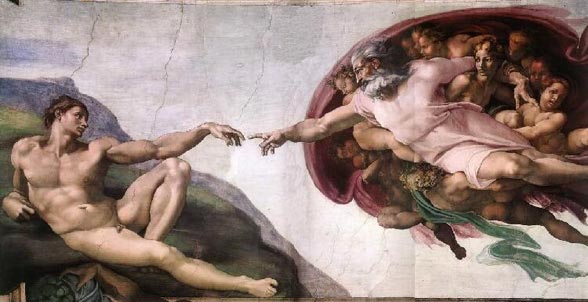 |
| God Creating Adam, Michelangelo di Lodovico Buonarroti Simoni, painted 1508-1512 |
Pope Julius II had persuaded Michaelangelo to decorate the ceiling of the Sistine Chapel although he initially resisted because he was primarily a sculptor. Now it would be difficult to deny that he produced one of the most iconic images ever created. The Sistine Chapel is in the Vatican Palace and is named for Pope Sixtus IV, who was responsible for it's restoration shortly before this masterpiece was made.
Michelangelo's painting is without precedent and changed the course of Western Art for ever; his technical genius was outstanding. The painting is a fresco (literally fresh in Italian) because the artist applies water-colour paints directly to freshly laid plaster so that the paint soaks into the plaster as it dries and the painting becomes an integral part of the wall.
It is interesting to compare this mural with Leonardo's Last Supper which was not a fresco and the paint of which began to peel after about sixty years and is now in a desperately poor condition. When God Creating Adam was cleaned a few years ago there were some who refused to believe it was the same painting because the colours were so vibrant!
God Creating Adam is one of six ceiling panels in the chapel which is constantly packed solid with crowds wanting to see the work. When I saw it some years ago a group of priests were ushering people through so one only got about five minutes viewing time!
What is remarkable about Michelangelo's depiction of God is that he is shown in a very human form, not aloof or wearing fine robes but, instead, with a muscular body and wearing a light tunic. He is seen in an intimate and accessible
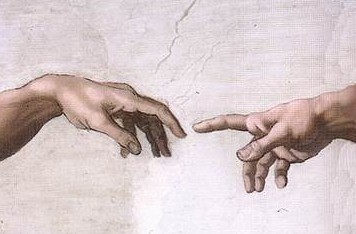
way which becomes moving and full of meaning. God and the angels are depicted inside a human brain (I bet you didn't notice that before!). The implication is that God is not only creating the physical form of Adam but imbuing him with intellect at the same time. The position of Adam's hand is relaxed and limp - he appears to not yet have been given life, whereas Gods hand is alert and active. We are witnessing the critical moment.
Listening to British folk-singer Kathryn Williams covering a couple of sad songs. Firstly, Velvet Underground's Candy Says
followed by Jackson Browne's These Days.
Friday, 18 December 2015
Bazza's 'Numbers Quiz' for Christmas
 |
| This year my traditional Christmas Quiz is not about Christmas but, instead, it's about numbers! |
Q1 Add the total number of dots on a standard die to the number of dominoes in a standard double-six set.
Q2 ‘A bronze desk’ is an anagram for a slang expression for which number? Subtract that number from the number of carats in pure gold.
Q3 Take the lowest number on a standard dart board that cannot be scored with a single dart and multiply it by the prime number that is nearest to ten.
Q4 What are you left with if you take the Meaning of Life, The Universe and Everything from the binary number 101010?
Q5 How many points do you score if you start a game of Scrabble with the word ZOO? Now take what oil does not do with water and turn that Roman number into an Arabic one and add it.
Q6 How long is a piece of string? I found some mixed length of string in a drawer. One piece was the same length, in feet, as a tennis court and another was the same number of feet in length as the number for a hurricane on the Beaufort scale. Add those numbers together.
Q7 Take the number of days of rain after The Flood and subtract the usual number of lines in a sonnet.
Q8 The Plieades star cluster has a much more common name which contains a number. Multiply that number by the number of stars in the Solar System!
Q9 Multiply the number of members of the UN Security Council with powers of veto by the number of the Apollo mission that first landed on the moon.
Q10 How many apples would you have if you took 15 apples out of a barrel of 200?
BONUS QUESTION: In case that wasn't hard enough for you here is a teaser to think about:
What numbers should replace the question marks in this sequence?
1, 50, 6, 45, 11, 40, 16, 35, 21, ? ?
1, 50, 6, 45, 11, 40, 16, 35, 21, ? ?
THE ANSWERS ARE NOW
POSTED IN THE COMMENTS!
POSTED IN THE COMMENTS!
Saturday, 5 December 2015
Painting of the Month (58): Dec. 2015, Edward Hopper

Night Windows, 1928.Oil on canvas, 29 x 34 inches.
The Museum of Modern Art, New York.
Edward Hopper, (1882-1967), specialised in painting night scenes of New York City. He showed views of bars, cafes, offices and domestic scenes. They evoked a real 'feel' of New York and frequently portrayed lonely individuals in unremarkable situations. At the time of this picture he was resident in Greenwich Village and this is a view into a neighbouring apartment. The woman is in an inelegant pose and seems to be oblivious of the viewer; the viewer becomes a voyeur. The way in which the woman is half out of view is something adapted from the work of Degas, someone whom Hopper admired, (see below).

We get a glimpse of someone's private space in the same way that one might do when looking out of a train window. The curtain blowing out of an open window suggests a summer evening and this scene is really more redolent of 1920's New York than views of skyscrapers; the isolation and urban loneliness of individuals who are actually crowded together is suggested. Hopper was always interested in the effects of light and this painting is almost a triptych with the three windows. Here are some other pictures by Hopper.
To me, each one of these paintings strongly suggests a narrative and a back-story :


Listening to Dissatisfied Blues by Brownie McGhee from the album Back Country Blues
Tuesday, 10 November 2015
New World, Second Movement
I have always enjoyed Dvorak's beautiful and moving New World Symphony. I was listening to it a few months ago when a part of the second movement suddenly started sounding familiar. Listen to the part I am talking about here. The melody begins at the 45 second point. A bit of research on the internet revealed that it is the basis for the melody of a song called Going Home which you can hear being sung by the extremely talented Norwegian soprano Sissel by clicking here.
However, I knew that wasn't really what was ticking a box in my memory and last Saturday on the very popular BBC radio Saturday morning programme Sounds of the Sixties my search was finally over. Before they had their big hits Sailing (later covered by Rod Stewart) and The Arms of Mary, The Sutherland Brothers & Quiver were known as A New Generation and they had a minor hit with a song that I had always liked at the time called Smokey Blues Away. Take a listen here and you will understand why I liked this poignant, sad song.
This song, as far as I can tell, is not available on any CD or digital source and vinyl copies are hard to get. So You Tube is one of the only ways to hear it!
 |
Sissel Kyrkjebø |
This song, as far as I can tell, is not available on any CD or digital source and vinyl copies are hard to get. So You Tube is one of the only ways to hear it!
Thursday, 8 October 2015
Wreckless Eric
When the punk rock explosion in the USA, the UK and Australia subsided in the late 1970s a second wave of so-called 'post-punk' or 'new wave' acts emerged.
 |
| Wreckless Eric in the 1970s |
Among these was the English singer Eric Goulden, known as Wreckless Eric. He made a few interesting albums and singles but for me two singles are outstanding.
Released on Stiff Records, they are, the much-acclaimed:
and Hit and Miss Judy (1979)
Click the titles to hear the songs (best played loudly!)
 |
| A little more recently! And if you would like to hear it sung in a Scottish accent, listen to the Proclaimers |
Subscribe to:
Posts (Atom)