"Many years later, as he faced the firing squad, Colonel Aureliano Buendia was to remember that distant afternoon when his father took him to discover ice."
Gabriel Garcia Marquez: "One Hundred Years of Solitude"
View my previous blog here: http://bazzablog-uk.blogspot.com
I reply to all comments except spam, no matter how old!
Please ignore any email address displayed here! My email is shamp123 AT sky.com
Saturday, 13 May 2017
Sunday, 30 April 2017
Painting of the Month (71) May 2017: Norman Rockwell
Norman Rockwell (1894-1978) was an American asrtist most famous for his cover illustrations for The Saturday Evening Post. He contributed over 300 covers during a period of more than 40 years. This picture served as a propaganda poster in World War 2 and was used as the magazine's cover in May 1943. Women were encouraged to fill the jobs left vacant when the men went to war and Rosie was a kind of ideal. She became a feminist icon.
| Norman Rockwell, Rosie The Riveter, 1943 |
Rockwell's model was a nineteen-year-old phone operator named Mary Doyle Keefe. She was a very petite young lady and said that Rockwell phoned her after the painting was completed to apologise for making her look so big. That was not an accident of course; the idea was to show that women could be strong and easily do men's jobs. The picture has iconic status in the United States and was sold to a museum for $5 million in 2002. Rosie is seen eating a ham sandwich with a huge (light-weight fake) riveting gun on her lap. She has her foot placed, symbolically, on a copy of Hitler's Mein Kampf. The picture was sent on a touring exhibition to encourage people to buy war bonds along with a set of four pictures called Freedom of Worship, Freedom from Fear, Freedom from Want and Freedom of Speech.
| The Four Freedoms |
Rockwell has often been dismissed as a proper artist largely because of the perceived "cartoonish" sentimentality of his subjects. Critics would say that he is an illustrator rather than an artist. He had no problem with that and even referred to himself as an illustrator. However, I think he is hard done by. His paintings show obvious great skill and technique with superb compositions. His work was not always sentimental. Consider the picture below.
| Norman Rockwell, The Problem We All Live With, 1964 |
This a very serious picture. The little girl is being escorted into a school in the south by US Marshalls. They are headless and the girl is highlighted to make sure that she captures your attention. Rockwell made her dress white (it was dark grey in reality) so that it formed a high contrast with her dark skin. The rest of the picture is fairly 'grey' with the shocking exception of the rotten tomatoes that have been thrown and the yellow armbands. Also the whole picture forms a golden rectangle as does the ratio, top left from her chest. None of this is accidental, including the way she appears the be 'boxed-in' by the marshals.
On a lighter note, much of the imagery in the film Forrest Gump is based on Rockwell's work.
And finally a look at a very typical and much reproduced early work:
| Rockwell Young Forrest Gump |
| Gazing at the Moon, 1926
I am listening to Betty Wright's Clean Up Woman. A brilliant 70s soul recording with fabulous guitar playing by Willie "Little Beaver" Hale.
|
Sunday, 23 April 2017
Esprit de l'escalier
Esprit de l'escalier, from the French literally meaning 'staircase wit' is a beautiful phrase which is used in English because staircase or escalator wit sounds clumsy and inadequate. The pronunciation is 'espree de lescaliay' (click the words to hear it on You Tube).
It is defined as "A witty remark thought of too late, on the way home [or as you go upstairs]; the clever comment you wish you had delivered". We've all been there!
A good example is from Seinfeld (which is packed with examples):
George has a conflict with one of his co-workers named Reilly, who notices George stuffing himself with shrimp cocktail at a meeting. He remarks: "Hey George, the ocean called; they're running out of shrimp." Slow-witted George cannot think of a comeback until later, while driving to the tennis club to meet Jerry. His comeback is: "Well, the Jerk Store called, and they're running out of you." George becomes obsessed with recreating the encounter so that he can make use of his comeback. Jerry, Elaine and Kramer disapprove of "jerk store" as a comeback mainly because "there are no jerk stores." Elaine suggests, "Your cranium called. It's got some space to rent." Jerry offers, "The zoo called. You're due back by six." Kramer finally suggests that George simply tell Reilly that he had sex with his wife.
This figure of speech should not be confused with a regular witty response. For example:
John Montagu: "Sir, I do not know whether you will die on the gallows or of the pox."
John Wilkes:"That will depend, my lord, on whether I embrace your principles or your mistress."
It wouldn't have been the same if Wilkes had written him a letter the next day with his riposte, would it?
I'm listening to Neil Young's Harvest Moon. After all these years I still enjoy hearing it.Click the title to listen.
Monday, 17 April 2017
Jackson Browne
I really like the music of Jackson Browne and have been listening to it for many years and have seen him in wonderful live-performance concerts a couple of times. He writes or co-writes most of his own material and is an excellent lyricist.
So, for your delectation and delight I have made links to five of his best songs on You Tube. Just click on the titles to be taken there!
| Jackson Browne, then and now. |
We begin with a recording made with the talented Irish musician Sharon Shannon of Man of Constant Sorrow.
Next is a song that he has to play in every live show. This live version is out of synch but it is from a unique album which featured all new songs recorded live in various places including backstage and hotel bedrooms but mostly on stage. For this song he always has the road crew on stage gathered around the piano to sing the backing. Enjoy Rosie.
This is a song which my wife Leah really loves and so do I. It's very different from his usual style but I never tire of listening to Linda Paloma.
Next up is a wistful song called Jamaica Say You Will. It has been recorded by Joe Cocker, Tom Rush, The Byrds and The Nitty Gritty Dirt Band among others.Lastly one his very best songs: The Pretender. A wry commentary on contemporary life with superb lyrics:
"I'm gonna be a happy idiot
And struggle for the legal tender,
Where the ads take aim and lay their claim
To the heart and soul of the spender.
And believe in whatever may lie
In those things that money can buy
Though true love could have been a contender.
Are you there? Say a prayer for The Pretender
Who started out so young and strong
Only to surrender."
Tuesday, 11 April 2017
Wanstead House
This is the tragic story of Wanstead House, a fabulous Great House which once stood in what is now Wanstead Park in suburban East London on the Essex border. It was recognised as one of the finest houses in Europe, a rival to Versailles. It's not there anymore and this the story of what the building and grounds were like and why the house is gone.
In England it was on a par with Kensington and Blenheim Palaces and it's architecture influenced the design of the Mansion House in central London, (the residence and office of the Lord Mayor of London).
Wanstead has been been occupied back into pre-history with stone-age flint axe-heads being discovered and a magnificent Roman mosaic was destroyed when Wanstead House was being developed. It was a Royal Deer Park bought by Henry VII in 1499 and his unruly son, the future Henry VIII, spent time there, where he could could be kept under parental control. There was a former palace on the site which was visited by Kings and Queens. Elizabeth I rode out there to meet her half-sister Mary with 1,000 knights on horse!
So the area was well-established when. in 1667 Sir Joshua Child, head of the fabulously wealthy East India Company purchased the estate which eventually fell into the hands of his son Sir Richard Child who commissioned the leading architect Colen Campbell to build a great house in 1715. It had a 60 feet wide portico supported by six Corinthian pillars in the neo-classical style which was quite innovative at that time and there were over 70 rooms. The estate passed down the family and it eventually came into the possession of the heiress Catherine Tylney-Long who, at the age of sixteen became the richest non-royal person in the land.
| The old house and gardens in 1710 shortly before the new building was begun |
| Wanstead House at it's finest |
| Sir Richard Child & family at Wanstead House By William Hogarth, 1738 |
created in the extensive grounds. Naturally Catherine had many suitors whom she rejected, including the future William IV, uncle to Queen Victoria. Eventually she succumbed to the charms of William Wellesley-Pole, nephew of the Duke of Wellington. The man was a complete scoundrel and as soon as he got his hands on the huge fortune he began to throw lavish parties and spending at an alarming rate. He eventually gambled away all of the money. At the age of 34 Catherine died of either suicide or a broken heart. Her ghost is said to haunts the area nowadays.
Bankruptcy meant the building had to be put up for sale in 1824. It had cost an incredible £360,000 to build but, as no buyer could be found, it was sold off brick-by-brick including all of the interior fittings, raising just £10,000. England had tragically lost one of it's greatest buildings.
Today the beautiful wild park is a tranquil place to stroll around the lakes or in the woods full of oak and sweet chestnut trees. There is plenty of wildlife to see including stoats, weasels and herons. A large part of Wanstead Park is now a golf course. The ruined grotto was where Robert Mitchum filmed the denouement of The Big Sleep. Although within in the London Borough of Redbridge it is officially a part of Epping Forest and is administered by the City of London Corporation. Many of the young families enjoying the bluebells and playing with their children have no idea of it's past and sad history.
| All that remains on the grounds today are the ruined Grotto and the Temple, now a Museum |
I'm listening to Bette Midler singing
John Prine's lovely, sad song
Hello in There. You can hear it here.
Tuesday, 4 April 2017
Painting of the Month (70) April 2017: Chagall
Marc Chagall was born in
1887 near Vitebsk, Belarus, at that time a part of the Russian Empire. He
occupies two main areas of modern painting; Picasso described him as the
last of the great modern colourists and he is also considered to be the
pre-eminent Jewish painter of the twentieth century. He was uneasy with that
description because, although Jewish themes dominated much of his work he was
very interested in modern painting generally.
I find this picture very romantic. It shows him with the love of
his life, his first wife Bella. He made a few versions of this picture and many
others where they are floating through the air in a dream-like state. In this
painting they are floating above his home town of Vitebsk. Below we can see the
houses but we are not looking up at the couple, instead we are at the same
height as them and looking directly across. The painting is heavily
cubist-influenced – note the way that their clothing is beginning to be
depicted as a series of individual shapes. Chagall went to Paris at a time when
Cubism was the major movement in painting although he returned home to paint
this just before the Russian revolution.
| Portrait of Chagall by his first art teacher who, it seems, could not paint hands. |
There is a suggestion of the Earth’s curvature which accents their
height. The symbolism indicates that the couple felt “lighter than air” because
of the love they felt for each other. They seem to almost be swimming (I don’t
care about splitting infinitives!), in a kind of back-stroke but they are
floating as well. So, active and passive at the same time!
Although this is an oil painting on canvas, the houses have the look of
a Japanese watercolour and I love the way one of the houses is painted entirely
in red. Incidentally, this picture was once considered to be almost pornographic because she is showing some bare wrist!
I don’t want to over-analyze here because I feel that the beauty of the
work speaks for itself. Chagall died as recently as 1985 at the age of
ninety-seven.
I'm listening to to the wonderful Joan Baez singing the achingly sad
Jesse a beautiful song written by Janice Ian. Listen here.
Saturday, 25 March 2017
Ozymandias
I met a traveller from an antique land
Who
said: “Two vast and trunkless legs of stone
Stand in the desert. Near them on the sand,
Half sunk, a shattered visage lies, whose frown
And wrinkled lip and sneer of cold command
Tell that its sculptor well those passions read
Which yet survive, stamped on these lifeless things,
The hand that mocked them and the heart that fed.
And on the pedestal these words appear:
`My name is Ozymandias, King of Kings:
Look on my works, ye mighty, and despair!'
Nothing beside remains. Round the decay
Of that colossal wreck, boundless and bare,
The lone and level sands stretch far away”.
Shelley has used the exotic ancient past of Egypt to demonstrate that
art can critique power and, perhaps, to make a statement about the politics of
his own time. Ozymandias may have been a despotic tyrant but his Empire and his
monument have been reduced to rubble – only the sneer remains and the inscription.
The traveller who is relating the story looks about him after reading it but
only sees the “Lone and level sands that stretch far away”. Nature is mightier
than the king and all of his power and glory is reduced to dust. The vast
desert is mocking human vanity and hubris. For me, this is an absolute masterpiece
Footnote: What does this poem have in common with Breaking Bad?
The final season of Breaking Bad follows Walter White as his meth-producing empire, metaphorically crumbles into the sand in the desert of New
Mexico. Near the end of the consistently brilliant series one of the best
episodes is called .........'Ozymandias'.
I have been listening to the brilliant but tragic Judee Sill singing The Kiss. You can hear it here. There is also a live version from the BBC which I find very emotional (but I'm a bit soppy).
Thursday, 16 March 2017
Painting of the Month (69) March 2017: Picasso
Les Demoiselles d'Avignon, Pablo Picasso, 1907
This is one of the most famous
paintings ever made but, even now, a hundred years after it was first exhibited
it tends to cause a strong reaction, often a negative one. I would like to
try to show why it is such an important picture and to explain some of the
pictorial elements and provide some contextual background. Pablo Picasso
painted the picture in 1907 but did not show it until 1916, knowing the
reception it was likely to receive. And the reaction was strong, even from his
fellow artists. Matisse, in many ways the antithesis of Picasso and his rival
to lead the avant-garde of modern painting, expressed his dislike as did
Georges Braque. Braque eventually began to appreciate the work and he and
Picasso went on to develop Cubism together.
The picture portrays five prostitutes
in a brothel on the Carrer d'Avinyó (so:
young ladies of Avignon Street, Barcelona, not of Avignon in
south-east France). The ladies are not demure, staring out of the picture in a
slightly aggressive or confrontational manner. It was meant to shock - and
it did! The work was deemed to be immoral when first exhibited in
public. Picasso originally called it Le Bordel d’Avignon but it was
given it's famous title by a critic who probably helped prevent total
public outrage. Picasso always disliked it's newer title and always preferred his
original title. He always would refer to it as "my brothel".
Every new breakaway movement in art,
however radical, owes much to what went before and below I have shown some
works which are acknowledged to have been influential in the creation
of this work.
El Greco, The Vision of St John, 1608. Often cited as an influence.
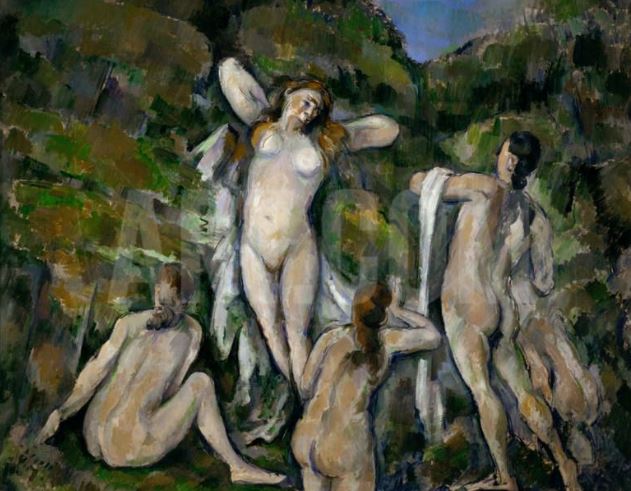
Paul Cezanne, Four Bathers, 1890
| Edouard Manet, Olympia, 1863. Note the defiant stare. |
Tuesday, 31 January 2017
Painting of the Month (68) Jan 2017: John William Waterhouse
John William Waterhouse (1849 - 1917) was a late-comer to the Pre-Raphaelite Brotherhood school of painting. He worked at a date which was late enough for him to show influences of Impressionism in some of his later work. His themes were pretty consistent throughout his career; ancient Greek mythology and Arthurian legend, often depicting women in a distinctly Pre-Raphaelite style.
| The Lady of Shalott by J W Waterhouse, 1888, Tate Modern, London The first and best of three versions he made of this subject.
Alfred, Lord Tennyson wrote his poem, The Lady of Shalott, based on medieval legends of King Arthur, in 1833 with a revised version in 1842. The story is that the lady was a prisoner in a tower on the island of Shalott which was situated in a river leading downstream to Camelot. We don't know who she was or why she was being punished but she could only see images of the world in her mirror. She weaved these images into a multi-coloured web but was under threat of an unknown curse if she looked upon Camelot or any of it's people. One day she saw and fell in love with Sir Lancelot, a Knight of the Round Table and her fate was sealed. We see her floating down toward Camelot and to her tragic demise.
The painting is an interesting mix of both symbolism and realism. The palette (range of colours used) is very autumnal as is the low-cast light level. I have sampled some of the these colours below to illustrate this point.
The artist has succeeded in maintaining a balance between realism and what we might call 'other-worldliness'. Her unkempt hair and the untidy reeds in the foreground along with her expression symbolises her despair. She could also be said to symbolise the position of women in Victorian Britain - she is not in control of her destiny. Waterhouse has kept a sense of realism with his clever use of depth in the background landscape and the surface of the water. As she emerges from the dark woods behind her she is brightly lit so she remains the focus of our attention. To her left you can see some steps leading down to the water, which I think she has just walked down to begin her fateful journey. There are three candles on the far side of the boat, only one of which is still burning and toward the bow of the boat is a crucifix, all of which symbolises her impending untimely death. Draped over the side of the boat is one of her tapestries, a direct reference to Tennyson's poem.
In summary, we have a realistic scene of a 'fairy-tale' woman heavily symbolic of both the time in which it was made and of faithful reference to Tennyson's poem.
Below are Waterhouse's two other paintings of this subject. In both works we can see her tapestry loom and, in the background, the mirror, her only view of the world until she looks at Lancelot.
Having just got back from a long weekend in France I'm feeling all Frenchified and I am listening to Françoise Hardy:
La maison où j'ai grandi (click to listen).
I used to be in love with her - probably still am. My wife understands....
|
Monday, 16 January 2017
The wonderful story of Agloe, New York
The protection of intellectual property can be a very difficult area for map-makers. The London A-Z map book is known to contain various non-existent streets.
The idea is that anyone copying the work of the publishers would be trapped in any legal action because they would copy the deliberate errors and be exposed. This is an age-old practice to keep the copycats at bay. Companies that create maps get their work pirated all the time. You might hire surveyors and draughtsmen, you might checks all of your spellings, you might get all of the towns and cities in the right place and another company comes along, say for example a tourist agency, and steals your work.
You cry 'Piracy!' and take them to court. "Prove it" they say "It's a map, it describes what is. Because there's a real world out there, obviously maps are going to be identical. So we're only guilty of describing the same world the other map described". Jurors think, "Hmm, sounds reasonable," and the pirates get away with it. Unless the mapmaker runs a little scam.
I am going to relate the fascinating story of what happened to a map published in the 1930s. The map-makers, Otto G. Lindberg and Ernest Alpers of the General Drafting Company of Convent Station, New Jersey, used an anagram of their initials, OGL and EA, to create the fictitious town of Agloe, New York. They sited it in a spot that they knew to be uninhabited 100m from the junction of Highway 206 and an, at-that-time, dirt road called Beaverkill Valley Road. So, were any plagiarist to copy their map, Agloe would in turn show up on the stolen property, and General Drafting Co. would have their proof.
| Google maps Street View couldn't get me any closer. |
Then one day it happened! Rand McNally, a big map distribution company, published a new New York map that showed Agloe on it. "Aha" thought Lindberg and Alpers "We've got 'em". But they were in for a shock when the case got to court.
A couple had bought a legal copy of General's map from Esso, who were the distributors, and chose Agloe as the spot to open a General Store. (You might wonder why they chose to open a store in a non-existent place but the town of Roscoe is very nearby and, anyway, that's what they did). Rand McNally countered the plaintiffs accusation by asking "How come the Agloe General Store exists (for that is what the couple had named their business) if there is no such place." And they won their case. Lindberg and Alpers had legitimately created a 'Paper Town' to protect their work but it became a reality and voided their legal claim that they had made it up and that it 'did not exist'!
The American Map Company bought and swallowed-up General Drafting in 1992 and Agloe continued to be included in their maps (maybe they didn't know it's history?). Google reportedly only removed it from their maps in 2013, eighty years after it first appeared. However, I just put 'Agloe' into a Google Maps search box and the location of the 'Agloe General Store (Closed)' was shown on Beaverkill Valley Road!
So, a made-up name for a made-up place inadvertently created a real place that, for a time, really existed.......and then didn't!
FOOTNOTE: John Green, who also wrote The Fault in Our Stars, based his mystery novel 'Paper Towns' on Agloe in 2008 and it was made into a Hollywood film in 2015. Apparently the film stinks. Perhaps it will disappear......
I am listening to Dave Edmunds 'Queen of Hearts'
Monday, 9 January 2017
Painting of the Month (67) Dec 2017: Gilbert & George
| Forward, Gilbert & George 2008, Stained Glass |
Gilbert and George are an oddity in the art world. They are Conservative, monarchists and anti-socialists. They do everything together, are never seen apart (they are a couple) and have been together since art school days. Gilbert Prousch was born in Italy in 1943 and George Passmore in England in 1942. They are often seen walking along together in the trendy parts of London's East End. They declined to be photographed with me when I ran into them a couple of years ago (I don't blame them really). They are strongly anti-elitist and have questioned why so many artists are left-wing socialists whom, they claim, tend to be all the same. Surely, they ask, artists should want to be different and individual? Their trade mark is that they are very often featured in their own work which they describe as 'scuptures'.
| Family Tree, Gilbert & George 1994, Photos pasted onto board |
They are irreverent, witty, obscenely rude, playful and fun. They are always immaculately dressed and are renowned for their highly-formal appearance, always in the same matching suits. I have made a collage of some of their photos below.
| I'm listening to the original version of Lets Stick Together by Wilbert Harrison |
Saturday, 31 December 2016
Thursday, 22 December 2016
The Keener's Manual
The late Richard Condon has long been one of my favourite authors. The novel that made him famous was The Manchurian Candidate. Other Hollywood successes were Winter Kills and the Prizzi's Honor series. He specialised in satirical black comedies usually centred around the political world. Winter Kills is a thinly-disguised take on the Kennedy family.
This is the book that was so nearly filmed by the Beatles as Eight Arms to Hold You but they made Help instead. Another example, from Condon's first novel The Oldest Confession, has this epigram in the front cover:
The Oldest Confession
Is one of Need,
Half the need Love
The other half Greed.
The title of the book was not always a direct quote. Prizzi's Glory of 1988 has this quote from the manual:The Oldest Confession
Is one of Need,
Half the need Love
The other half Greed.
Seeking good fortune
As we rise from the mud,
'Tis often we're paid
From a purse filled with blood.
But here's the point of this post - although I had tried for years to find a copy of The Keener's Manual, no librarian was able to help me. Eventually I discovered that it has never existed; it's existence was completely fabricated by Condon as were all of the quotes! There are several other examples of this kind of thing. One that springs to mind is the extensive use of footnotes about the scientist de Selbey in Flann O'Brien's The Third Policeman. The footnotes must comprise about a quarter of the book.
Another interesting fact about Condon's novels is that every one of them featured a character named Frank Heller but he was a different person in each book. Condon would often use the names of friends and acquaitances as characters and, at one time, proposed the idea of having a central register of character names that authors could safely use as they wished. I don't know how serious he was about that idea.
Wednesday, 14 December 2016
Lapis Lazuli
Lapis Lazuli, the name comes from Lapis, Latin for 'stone' and Lazhuward, Persian for 'blue'. It has been mined almost exclusively, in north-eastern Afghanistan and a part of Pakistan for nine centuries. It was used to fashion the eyebrows on the funeral mask of Tutankhamen over 3,300 years ago.
It is a mineral rock which provides the most intense deep blue pigment. When it began to be imported into Europe in the Middle Ages, blue was a difficult and expensive colour for artists to obtain and it became the basis of French Ultramarine paint for centuries until artificial pigment could be manufactured. This had the effect of making it rare and costly so that it became a status symbol in art in much the same way as gold leaf.
| The Madonna, Sassoferrato, 17th century |
It is useful to bear in mind that this rule, as with all symbolism, should not be seen as immutable; artists were free to create alternative values but the 'meaning' of a picture would often need to be 'read' through it's depictions and colours.
I'm listening to George Harrison singing
Bob Dylan's 'If Not For You' from
All Things Must Pass.
Sunday, 27 November 2016
Painting of the Month (66) Nov 2016: Caravaggio
I am back after taking a short break from Blogging
and hope to visit many Blogs over the next few weeks!
| Caravaggio: Judith Beheading Holofernes 1598-99 |
OK, the subject matter is a bit grim; The Book of Judith is in the Catholic Old Testament but
not in the Hebrew or Protestant versions. It is found
in the Apocrypha because some scholars consider it's many
anachronisms cause them to relegate it’s status. It has even been described as the 'first historical novel'!
However, this post is about Caravaggio and his painting. Michelangelo Merisi Merigi da Caravaggio was born
in Milan in 1571 and died, probably murdered by any of a number of people out
for revenge, in 1610 aged 38. His life was tumultuous even by the standards of
those times. He frequently had to relocate his home after being involved in drunken
brawls.
His painting
style is usually considered to be early Baroque which is complex but broadly
can be associated with the Catholic Church trying to re-assert itself in the
face of Protestant reform.
This painting
has many very interesting aspects. It captures the highly dramatic moment of
decapitation. There is another superb painting of this subject by Artemisia
Gentileschi which I have shown below.
For me, what separates the two pictures is the expression on Judith’s face in
the Caravaggio version. It seems to convey her repulsion and determination at
the same time. Caravaggio had witnessed the public execution by beheading of Beatrice Celini in Rome and he has managed to convey the horrific moment when a man loses his life with incredible anatomical detail. One would usually'read' a painting left to right but this composition is unusual in that the two women enter from the right.
Caravaggio is renowned for his importance in developing the style known as Chiaroscuro. This involves the use of strong contrasts often used in religious painting where a dramatic shaft of light illuminates the subject.
| Artemisia Gentileschi: Judith Beheading Holofernes 1614-20 |
Artemisia Gentileschi was extremely unusual in being an, eventually, recognised female artist of the very highest quality.
Subscribe to:
Posts (Atom)